What is a Klebebeschlag (glue-on shoe)?
Function, Application, Durability & Benefits Explained Professionally
Table of contents
Klebebeschläge are nail-free, permanently attached hoof protection systems. Their quality is shown in how they influence the hoof mechanism, the force distribution and the behaviour under load . Durability and suitability are context-dependent and stand or fall with fitting and application.
You may already have come across the term Klebebeschlag or glue-on iron and asked yourself how this system actually works, how durable it is and which horses it makes sense for.
In this article you will learn:
what a Klebebeschlag is in technical terms – and why „Beschlag“ describes the function on the hoof, not the type of attachment
why hoof protection is more than wear protection – and what role hoof mechanism, force distribution and load play in this
how a Klebebeschlag works in practice – from hoof trimming to fitting to gluing
how long a Klebebeschlag lasts – and which factors influence hold and function under load
which benefits can be assessed objectively – particularly with regard to depth of intervention, adaptability and reversibility
for which horses and use cases a Klebebeschlag can make sense – and where its technical limits lie
how Klebebeschlag, iron shoe and barefoot differ functionally – without ideological judgement
The aim is an objective, comprehensible assessment – not an ideological judgement.
Fundamentals of the Klebebeschlag
The hoof as a functional organ – why hoof protection is more than wear protection
In order to assess a Klebebeschlag sensibly, it must first be clarified how the hoof is fundamentally understood.
The hoof is not a passive contact surface, but a functional organ in the horse’s locomotor system. At the same time, it performs:
- load uptake and load distribution
- shock absorption
- stabilisation and balance
- transfer of forces into tendons, joints and muscles
What is decisive:
Movement at the hoof takes place under load . The hoof deforms when landing and returns to shape when lifting off. This dynamic behaviour is called the hoof mechanism.
Every form of hoof protection intervenes in this system. The question is not whether it intervenes – but how strongly and in what way.
A Klebebeschlag is therefore not just wear protection. It is a tool in load management and must be measured by how it:
- preserves or restricts the hoof mechanism
- distributes forces
- behaves under real use
What exactly is a Klebebeschlag?
A Klebebeschlag is permanently attached hoof protection that is not nailed, but glued.
An important terminological clarification:
A „Beschlag“ describes the function on the hoof – not the type of attachment.
A Beschlag performs:
- protection against wear
- load uptake
- force distribution
- influence on the breakover
- load management during use
Whether this protection is nailed or glued is technically relevant – functionally it remains a Beschlag.
A Klebebeschlag is therefore:
- a nail-free Beschlag
- permanently attached hoof protection
Which Klebebeschläge are available?
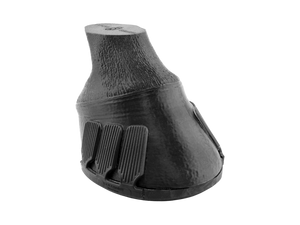
In principle, Klebebeschläge can be divided into two main categories: prefabricated shell or complete systems and individually fitted, modular systems.
Prefabricated systems usually consist of a rigid shell that is attached to the hoof with a two-component adhesive. They are available in defined sizes and are applied with as little adaptation as possible.
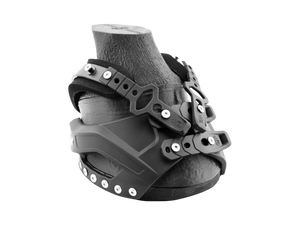
Individual Klebebeschläge, by contrast, are based on a separately fitted base plate to which glue tabs or glue collars are welded and then bonded to the hoof wall. These systems are more variable in shape, stiffness and design and allow more precise adaptation to anatomy, use and load.
Beyond that, glue-on irons differ in material properties (e.g. flexibility, wear behaviour, sliding behaviour), depth of intervention, expandability and orthopaedic modification options. Which system makes sense depends not on the term „Klebebeschlag“ alone, but on the respective use context, the hoof situation and the desired functional goal.
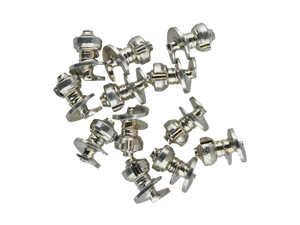
Depending on manufacturer and system, glue-on irons are available in different sizes – from small pony hooves to large-framed coldbloods. In addition, there are variants designed specifically for sporting demands which, for example, allow the integration of studs . This means competition horses can also be equipped with additional grip under slippery conditions, provided the relevant rules permit it. What remains decisive, however, is always the professional selection of the system in relation to discipline, surface and load profile.
Application and durability
How is a Klebebeschlag glued to the hoof?
With the Klebebeschlag, an individually fitted base plate with tabs is attached to the hoof wall. Attachment is done using a special adhesive.
The key difference compared to the nailed horseshoe:
- Nails fully penetrate the hoof wall.
- Glue systems bond superficially with the outer wall layer.
Mechanically, this means:
- no localised nail tension
- no penetration of the horn structure
- lower structural depth of intervention
This does not mean that one system is fundamentally „better“ – but rather that the intervention at the hoof is technically different from traditional shoeing with nailed horseshoes.
An individually made Klebebeschlag is produced by a farrier in several steps:
1. Professional hoof trimming
The hoof is first prepared functionally as for any form of shoeing. Technically clean hoof trimming is a prerequisite for the function and durability of the system. The hoof should be correctly trimmed, prepared to bear load and free of loose horn. Inadequate preparation is among the most common causes of premature durability problems.
The Goodsmith Klebebeschlag can either be applied to your horse by your farrier or hoof care professional, or by a Goodsmith partner near you.
2. Fitting the base plate
The base plate is fitted exactly to the individual hoof shape of the horse. A precise fit is decisive for:
- seat
- durability
- even force distribution
3. Welding base plate and tabs
Tab collars are permanently joined to the base plate using heat. This creates a modular system.
4. Preparing the hoof wall
The hoof wall is cleaned & degreased and the outermost horn layer is lightly roughened. Only the surface is treated. The structural integrity of the hoof capsule is preserved.
Before bonding, the bonding surface must be completely clean, dust-free and grease-free. Depending on the system, treatment with a suitable cleaner can be useful to optimise adhesion. The quality of the preparation significantly influences subsequent durability.
5. Bonding the tabs to the hoof
The tabs are attached to the hoof walls with special adhesive .
The Goodsmith adhesive is based on cyanoacrylate. Curing is triggered by moisture. The hoof therefore does not have to be completely dry. The adhesive is single-component and does not generate heat during curing. The Goodsmith XT-40 instant adhesive is also used in human medicine and is suitable for application on the hoof. It acts exclusively on the surface and does not penetrate living tissue. The adhesive is therefore non-toxic and does not damage the hoof horn.
An excessive amount of adhesive is not required for a stable bond. An even, thin layer is enough to achieve secure adhesion. Adhesive applied too thickly can even negatively affect the bond.
After a short curing time, the shoe is ready to bear load. Before final fixing, the fit should be checked once more. A stress-free, precise fit reduces leverage forces and contributes significantly to durability. Errors in fitting or in the gluing process are a more common cause of premature detachment than material failure.
The Klebebeschlag is ready!
Removing the Klebebeschlag:
To remove it, the tabs are taken off in a controlled manner with pliers. Adhesive residues can be sanded off.
When applied correctly, the structural integrity of the hoof wall is preserved.
Limits exist where:
- the hoof wall is severely damaged
- use and system do not match each other
- fitting is not done professionally
How long does a Klebebeschlag last?
The question „How long does a Klebebeschlag last?“ can only be answered sensibly if it is clarified what „lasting“ means.
Durability includes :
mechanical seat
preservation of function under load
behaviour over time
Durability is less a property of the material alone than the result of fitting, preparation and use. With professional application, the gluing intervals usually correspond to the customary shoeing intervals of classic systems. If, on the other hand, a Klebebeschlag is applied improperly, it can come off under load after just a few days – not because of the principle, but because of faulty execution.
In most cases, durability corresponds at least to the classic iron shoeing. The recommended trimming interval is 6–8 weeks. The Goodsmith glue-on irons can normally be reused for 2–3 shoeing intervals. In extreme cases, they can also be used for up to 4 shoeing intervals or half a year.
Actual durability depends on:
surface
training intensity
hoof growth
fit
professional application
material properties
What significantly influences durability?
The more precisely the glue-on iron is fitted to the hoof, the more evenly forces are distributed.
Clean and correctly prepared bonding surfaces are a prerequisite for stable hold.
A correctly set breakover point reduces leverage forces and minimises the risk of the horse stepping off the shoe.
What happens if a Klebebeschlag comes off?
As with any shoeing, it can happen that a horse steps on its own glue-on iron.
Modern systems often have predetermined breaking points in the tabs. In the event of strong leverage, these tear in a controlled way to avoid damage to the hoof wall.
What does a Klebebeschlag cost?
The costs for a Klebebeschlag depend on several factors:
region and business
individual fitting
choice of material (base plate, tabs)
possible modifications (e.g. wedges, pads, spikes)
In practice, an individually fitted Klebebeschlag is usually moderately above the price of a classic iron shoeing. The difference arises above all from the higher fitting and labour effort – not from the material alone. Working time is therefore a significant cost factor with glue-on irons.
Is a Klebebeschlag „expensive“?
Whether hoof protection is expensive depends on the benchmark. What is decisive:
What load is to be managed?
How relevant is the measure for the long-term use of the horse?
What functional added value does the system offer in the respective context?
Nail-free, adaptable hoof protection is generally somewhat higher-priced because it is individually made, reversibly attached and designed for movement under load.
Economic efficiency is therefore shown not only in the individual price, but in the overall course over several shoeing intervals – particularly when material components can be reused.
Conclusion:
A Klebebeschlag is usually somewhat more cost-intensive than a classic shoeing, but the price difference is technically justified by fitting and system design. Whether it makes sense depends on the respective horse and use context.
Benefits and areas of use
The benefits of a Klebebeschlag
Preservation of the hoof mechanism
Since no nails are driven through the hoof wall, there are:
no localised zones of tension
no penetration of the horn capsule
Movement-friendly systems can, depending on material design, allow a more barefoot-like deformation under load than rigid systems such as iron shoes. Hoof health can thus be promoted in the long term when using glue-on irons, since the natural hoof mechanics are preserved. Furthermore, plastic shoes are significantly lighter than iron shoes, which can improve the horses’ mobility.
Decisive, however, is always the specific execution.
Adaptability
Klebebeschlag systems are usually modular in design and allow differentiated adaptation to the respective hoof situation.
These include:
modular extensions
orthopaedic modifications
variable reinforcements
Reversibility
Adaptability is a central criterion because hooves change over time. Growth, trimming cycles, training intensity, surface, metabolism or rehabilitative processes in the horse continuously influence form and load situation.
An adaptable system makes it possible to respond to these changes.
Depth of intervention
Mechanically, gluing is a superficial intervention in the hoof wall, whereas nailing fully penetrates the horn structure.
This means:
- structural integrity is preserved
- repeated nail holes are avoided
Load management
Depending on material design, a Klebebeschlag can:
- dampen impact loads
- distribute force peaks
- allow controlled sliding behaviour
thereby cushioning impacts and sparing joints and tendons.
Too abrupt a stop can be just as unfavourable as excessive sliding. The goal, however, is not maximum softness, but controlled force transmission with balanced sliding and grip behaviour.
Which horses is a Klebebeschlag suitable for?
The question is not: „Which system is better?“
But: „Which system best meets the defined criteria under the given conditions for the respective horse?“
Barefoot can be the biological reference model under suitable conditions.
Iron shoes offer robust protection, but intervene rigidly in the hoof mechanics.
Klebebeschläge represent a nail-free, potentially more movement-friendly option. The glue system holds at all temperatures – meaning the glue systems can be used in summer in the heat as well as in winter in the cold. Different surfaces are not a problem, making them a solution for various situations and thus for many horse owners.
Which system makes sense depends on:
Function
Load
Objective
Adaptability
A blanket assessment is not technically tenable.
Different disciplines
Klebebeschläge are used today in:
Leisure and trail riding
Dressage
Showjumping
Western sports
Endurance riding
Eventing
Gaited horse sports
For sporting use scenarios, systems are available that can accommodate additional traction elements such as studs. As a result, Klebebeschläge are not limited to leisure use, but can – with correct design – also be used in competition.
In many competition regulations, Klebebeschläge are permitted – Goodsmith glue-on irons are LPO compliant.
. The rules should always be checked individually, however.
Can Klebebeschläge also help with orthopaedic problems?
Through modular extensions, Klebebeschläge can also be used for:
- limb deviations
- asymmetric loads
- rehabilitative measures
.
Important:
Klebebeschläge are not a promise of healing. They are a tool in mechanical load management and should be used in coordination with veterinarians and hoof care professionals in complex pathological situations. They can, however, provide relief for example for horses with arthrosis and hoof rest.
Limits and alternatives
When is a Klebebeschlag not suitable?
There are situations in which a Klebebeschlag is only of limited or no use:
- When the hoof must be fully immobilised (e.g. with certain fractures)
- With a severely damaged or strongly fungus-infested hoof wall
- When there is too little load-bearing bonding surface available
In such cases, an individual decision must be made as to which system is technically appropriate.
Klebebeschlag vs. iron shoe vs. barefoot
| Criterion | Klebebeschlag | Nailed iron shoe | Barefoot |
| Depth of intervention | low – superficial bond | high – penetration of the hoof wall | low – no technical intervention |
| Freedom of movement | high | limited | high |
| Protective effect | high | high | depends on horn quality |
| Adaptability | high – modular possible | limited | naturally given |
| Reversibility | high | limited – nail holes remain | high |
Summary
A Klebebeschlag is a nail-free, permanently attached hoof protection that intervenes mechanically in the hoof structure differently from a nailed shoeing.
Its benefits lie in particular in:
- lower structural depth of intervention
- adaptability
- reversibility
- potentially more movement-friendly design
Its suitability is – as with any hoof protection – context-dependent and must be assessed individually.
The question is not: „Which system is better?“
But: „Which system best meets the defined criteria under the given conditions?“
FAQ
Is a Klebebeschlag more expensive?
As a rule, the labour effort is somewhat higher than with a classic iron shoeing. The price difference results primarily from fitting time, not from the material alone.
Is plastic wear-resistant?
Modern plastics can achieve service lives comparable to metal shoes under similar use. Wear is always use-dependent. Our glue-on irons can normally be used for 2–3 shoeing periods of 6–8 weeks. In extreme cases even for up to 4 shoeing intervals or half a year.
Are Klebebeschläge just a trend?
Klebebeschläge have been continuously developed for many years. Their assessment should be based on clear criteria, not on market perception.
Can a Klebebeschlag be reused?
Depending on the condition of the base plate and wear, reuse may be possible. This must be decided individually.