 Find a hoof expert
 Become a partner

Adhesives for Glue-On Shoes – Differences and Characteristics
Alternative hoof protection – that is, alternatives to traditional shoeing – is enjoying ever greater popularity in the equine world. There are many good reasons for this (more on this in our article "What makes good hoof protection?"), and while in the past it was mainly hoof boots, various versions of glue-on hoof protection ("glue-ons" or "glue-on shoes") are now on the rise. Glue-ons have a multitude of advantages: not only can hooves develop very well with them, but they are also very easy for you as a horse owner in daily life. Once glued on, you don't have to worry about anything until the next farrier appointment – simple picking out of the hooves is usually sufficient as a care measure.
Nevertheless, there is still skepticism towards glue-on shoes; the most common concern is that the glue damages the hoof. We therefore want to examine this aspect in a bit more detail and take a look at the differences and specifics.
Not all glue-on shoes are the same
First, the different gluing systems need to be differentiated. Because: not all glue-on hoof protection is the same! Broadly speaking, the current systems on the market can be divided into two categories:
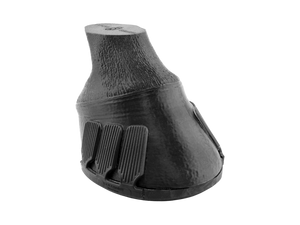
- prefabricated shells that are attached to the hoof over a large surface area using two-component adhesive (2K adhesive)
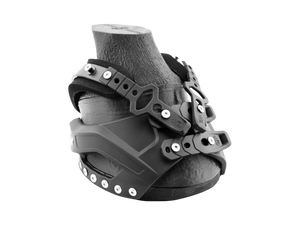
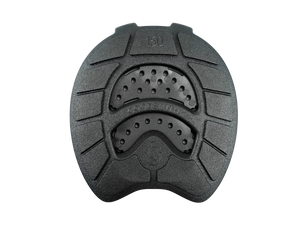
- individually adapted base plates that are fixed to the hoof wall at specific points using welded-on tabs and superglue (the Goodsmith belongs to this variant)
With both variants, it is important to emphasise that the adhesive only bonds to the hoof wall – no glue is applied to the sole.
Apart from this commonality, however, these two systems differ fundamentally and also have different effects on the horn material.
2K adhesive or superglue?
Let's first take a closer look at the chemical basis of the two variants. Both systems belong to the group of "chemically curing adhesives", which simply means that both glues harden by means of a chemical reaction.
Superglue based on cyanoacrylate
Superglues are adhesives made of cyanoacrylate, and the chemical reaction is triggered by water molecules. Normal humidity is already sufficient for this. This glue therefore absolutely requires moisture to harden, which makes it very easy to use on the horse, as the hooves do not need to be completely dry.
This is also the reason why you should be careful when handling superglue: in principle, cyanoacrylate is not dangerous to organisms, which is why these adhesives are also used for gluing in aquariums and in medical wound adhesives. But because they consume moisture as they harden, they slightly dry out the surfaces of the parts being glued. On healthy skin (and hoof horn) this is harmless, but the glue should not come into contact with tissue with a high moisture content, such as eyes and mucous membranes, as a great deal of moisture would be extracted very quickly here.
As with many chemical reactions, heat is also released when superglue cures. However, the heat development with this type of glue is very low, because cyanoacrylates only harden well (and therefore bond reliably) when used in a very thin layer (<0.2mm). With such small quantities, the waste heat is barely perceptible even on our human skin, and is therefore also harmless for the hoof.
Two-component adhesives
With 2K adhesives, there are various chemical compositions. In each case, there is a base material that is mixed with a hardener, reacts with it, and thereby cures.
As with superglue, heat is also generated during curing with 2K adhesives due to the chemical reaction. However, since 2K adhesive is applied more thickly than superglue, more heat is also generated here. A healthy horse hoof with a sufficiently thick hoof wall (at least 5.4mm) provides a good insulating layer against the higher temperatures. However, caution is required when dealing with damaged hoof walls (e.g. with nail holes) or very thin hoof walls (due to breaking away, thin rasping, or simply due to very small size in foal or pony hooves), as the heat can indeed penetrate as far as the corium and may cause damage. There are hardly any studies on this so far (and if there are, they tend to deal with the effects of a hot-applied horseshoe rather than plastic glue-ons), but generally proteins are irreparably damaged from 45°C – and hoof horn consists predominantly of proteins.
Apart from the increased heat development, the thickly applied layer of 2K adhesive has another disadvantage: the hoof is sealed over a large area in this region. Whereas with the gluing method using tabs and superglue, some free area always remains between the tab necks (where the hoof can "breathe"), with 2K adhesives a large area of the wall is usually sealed with glue right down to the bearing edge. Since the hoof continuously releases moisture, however, a damp environment can develop behind the glue layer. For a healthy hoof this is normally unproblematic, but caution is advised if the hoof is already damaged (by cracks, nail holes, brittle horn, etc.), as this can otherwise lead to increased bacterial and fungal accumulation in the hoof wall.
But what about the chemical ingredients of 2K adhesives? Do these directly damage the hoof horn? To answer this, we need to inspect the base materials a little more closely.
2K adhesives based on polyurethane (PUR)
Most 2K adhesives in the area of the horse's hoof are based on polyurethane. Polyurethane is the primary component of this gluing system. Isocyanate is used as a hardener: as soon as the polyurethane is mixed with isocyanate, the chemical curing reaction starts. In the process, the isocyanates are released again as vapour. Isocyanates can, however, damage cell membranes and therefore cause skin irritation. In particular, they should not be inhaled.
When used on the horse's hoof, the danger is low, as this work is usually carried out in well-ventilated places or outdoors. Nevertheless, when using PU adhesives, you should ensure that the glue does not come directly into contact with the skin and that no vapours are inhaled during curing – neither by you nor by your horse.
2K adhesives based on methyl methacrylate (MMA)
Methyl methacrylate is used in many areas of plastics technology, including for the manufacture of acrylic panels, in dentistry, as bone cement, and for modelling artificial nails. However, methyl methacrylate can cause skin irritation and contact allergies, which is why increased safety precautions are recommended in all areas of application. Human skin should not have direct contact with methyl methacrylate, and in particular it should not be inhaled (e.g. sanding dust from these plastics). It can therefore be assumed that the same applies to our horses.
To what extent MMA adhesives can damage hoof horn – there are no confirmed findings on this. However, since the horn capsule is dead tissue, it is not to be assumed that direct damage can be caused. Direct contact with living tissue (e.g. exposed corium) must, however, absolutely be avoided.
Do the cleaners used damage the hoof?
Apart from the adhesives themselves, further chemicals also come into contact with the hoof during glue-on applications: namely, the cleaners used to prepare the hoof wall for the glue.
Depending on the type of adhesive and manufacturer, various cleaning agents are recommended, with which both the hoof wall and the glue-on itself are to be degreased and cleaned:
- Alcohol (spirit/ethanol, (iso-)propanol)
- Acetone (nail polish remover)
- Brake cleaner
While alcohol is largely classified as harmless for external application, acetone and brake cleaner are regarded as harmful to health. However, the harmfulness relates primarily to the vapours, i.e. inhalation can irritate the respiratory tract.
On healthy skin, on the other hand, they merely have a drying effect, which is why a similar effect can be assumed on the hoof.
Conclusion
In summary, one can say: if your horse receives a glue-on shoe, the hoof comes into contact with various types of chemical substances. Most of these are harmless, at least in their direct effect on the horn material. Some of the chemicals, however, emit vapours during application that should not be inhaled – if the gluing is carried out outdoors, though, the risk of health problems is very low.
Caution should be exercised, however, in the case of existing horn damage: if the hoof wall is already thin, brittle, or damaged by cracks or nail holes, not all gluing systems are equally well suited. In particular, the heat development and sealing of the hoof wall must be taken into account here, which is why tab systems with superglue are often the best choice for such hooves.
Here you can go directly to the Goodsmith XT-40 Pro adhesive;)
Author: Nathalie Kurz
Images: Lenina Stienen, Bennet Klein
>> Sources
- https://faszination-kleben-dichten.de/aussergewohnliches/mit-klebstoff-sogar-wunden-versorgen/
- https://www.3maustria.at/3M/de_AT/kleben-und-verbinden-at/konstruktionsklebstoffe/faqs/
-
{"@context":"http:\/\/schema.org\/","@id":"\/en\/blogs\/wissensdatenbank\/ist-der-kleber-von-klebebeschlagen-schadlich-fur-den-huf#article","@type":"Article","mainEntityOfPage":{"@type":"WebPage","@id":"https:\/\/good-smith.com\/en\/blogs\/wissensdatenbank\/ist-der-kleber-von-klebebeschlagen-schadlich-fur-den-huf"},"articleBody":"Alternative hoof protection – that is, alternatives to traditional shoeing – is enjoying ever greater popularity in the equine world. There are many good reasons for this (more on this in our article \"What makes good hoof protection?\"), and while in the past it was mainly hoof boots, various versions of glue-on hoof protection (\"glue-ons\" or \"glue-on shoes\") are now on the rise. Glue-ons have a multitude of advantages: not only can hooves develop very well with them, but they are also very easy for you as a horse owner in daily life. Once glued on, you don't have to worry about anything until the next farrier appointment – simple picking out of the hooves is usually sufficient as a care measure.\nNevertheless, there is still skepticism towards glue-on shoes; the most common concern is that the glue damages the hoof. We therefore want to examine this aspect in a bit more detail and take a look at the differences and specifics.\n\nNot all glue-on shoes are the same\nFirst, the different gluing systems need to be differentiated. Because: not all glue-on hoof protection is the same! Broadly speaking, the current systems on the market can be divided into two categories:\n\nprefabricated shells that are attached to the hoof over a large surface area using two-component adhesive (2K adhesive)\nindividually adapted base plates that are fixed to the hoof wall at specific points using welded-on tabs and superglue (the Goodsmith belongs to this variant)\n\nWith both variants, it is important to emphasise that the adhesive only bonds to the hoof wall – no glue is applied to the sole.\nApart from this commonality, however, these two systems differ fundamentally and also have different effects on the horn material.\n2K adhesive or superglue?\nLet's first take a closer look at the chemical basis of the two variants. Both systems belong to the group of \"chemically curing adhesives\", which simply means that both glues harden by means of a chemical reaction.\nSuperglue based on cyanoacrylate\nSuperglues are adhesives made of cyanoacrylate, and the chemical reaction is triggered by water molecules. Normal humidity is already sufficient for this. This glue therefore absolutely requires moisture to harden, which makes it very easy to use on the horse, as the hooves do not need to be completely dry.\nThis is also the reason why you should be careful when handling superglue: in principle, cyanoacrylate is not dangerous to organisms, which is why these adhesives are also used for gluing in aquariums and in medical wound adhesives. But because they consume moisture as they harden, they slightly dry out the surfaces of the parts being glued. On healthy skin (and hoof horn) this is harmless, but the glue should not come into contact with tissue with a high moisture content, such as eyes and mucous membranes, as a great deal of moisture would be extracted very quickly here.\nAs with many chemical reactions, heat is also released when superglue cures. However, the heat development with this type of glue is very low, because cyanoacrylates only harden well (and therefore bond reliably) when used in a very thin layer (\u0026lt;0.2mm). With such small quantities, the waste heat is barely perceptible even on our human skin, and is therefore also harmless for the hoof.\nTwo-component adhesives\nWith 2K adhesives, there are various chemical compositions. In each case, there is a base material that is mixed with a hardener, reacts with it, and thereby cures.\nAs with superglue, heat is also generated during curing with 2K adhesives due to the chemical reaction. However, since 2K adhesive is applied more thickly than superglue, more heat is also generated here. A healthy horse hoof with a sufficiently thick hoof wall (at least 5.4mm) provides a good insulating layer against the higher temperatures. However, caution is required when dealing with damaged hoof walls (e.g. with nail holes) or very thin hoof walls (due to breaking away, thin rasping, or simply due to very small size in foal or pony hooves), as the heat can indeed penetrate as far as the corium and may cause damage. There are hardly any studies on this so far (and if there are, they tend to deal with the effects of a hot-applied horseshoe rather than plastic glue-ons), but generally proteins are irreparably damaged from 45°C – and hoof horn consists predominantly of proteins.\nApart from the increased heat development, the thickly applied layer of 2K adhesive has another disadvantage: the hoof is sealed over a large area in this region. Whereas with the gluing method using tabs and superglue, some free area always remains between the tab necks (where the hoof can \"breathe\"), with 2K adhesives a large area of the wall is usually sealed with glue right down to the bearing edge. Since the hoof continuously releases moisture, however, a damp environment can develop behind the glue layer. For a healthy hoof this is normally unproblematic, but caution is advised if the hoof is already damaged (by cracks, nail holes, brittle horn, etc.), as this can otherwise lead to increased bacterial and fungal accumulation in the hoof wall.\nBut what about the chemical ingredients of 2K adhesives? Do these directly damage the hoof horn? To answer this, we need to inspect the base materials a little more closely.\n2K adhesives based on polyurethane (PUR)\nMost 2K adhesives in the area of the horse's hoof are based on polyurethane. Polyurethane is the primary component of this gluing system. Isocyanate is used as a hardener: as soon as the polyurethane is mixed with isocyanate, the chemical curing reaction starts. In the process, the isocyanates are released again as vapour. Isocyanates can, however, damage cell membranes and therefore cause skin irritation. In particular, they should not be inhaled.\nWhen used on the horse's hoof, the danger is low, as this work is usually carried out in well-ventilated places or outdoors. Nevertheless, when using PU adhesives, you should ensure that the glue does not come directly into contact with the skin and that no vapours are inhaled during curing – neither by you nor by your horse.\n2K adhesives based on methyl methacrylate (MMA)\nMethyl methacrylate is used in many areas of plastics technology, including for the manufacture of acrylic panels, in dentistry, as bone cement, and for modelling artificial nails. However, methyl methacrylate can cause skin irritation and contact allergies, which is why increased safety precautions are recommended in all areas of application. Human skin should not have direct contact with methyl methacrylate, and in particular it should not be inhaled (e.g. sanding dust from these plastics). It can therefore be assumed that the same applies to our horses.\nTo what extent MMA adhesives can damage hoof horn – there are no confirmed findings on this. However, since the horn capsule is dead tissue, it is not to be assumed that direct damage can be caused. Direct contact with living tissue (e.g. exposed corium) must, however, absolutely be avoided.\nDo the cleaners used damage the hoof?\nApart from the adhesives themselves, further chemicals also come into contact with the hoof during glue-on applications: namely, the cleaners used to prepare the hoof wall for the glue.\nDepending on the type of adhesive and manufacturer, various cleaning agents are recommended, with which both the hoof wall and the glue-on itself are to be degreased and cleaned:\n\nAlcohol (spirit\/ethanol, (iso-)propanol)\nAcetone (nail polish remover)\nBrake cleaner\n\nWhile alcohol is largely classified as harmless for external application, acetone and brake cleaner are regarded as harmful to health. However, the harmfulness relates primarily to the vapours, i.e. inhalation can irritate the respiratory tract.\nOn healthy skin, on the other hand, they merely have a drying effect, which is why a similar effect can be assumed on the hoof.\nConclusion\nIn summary, one can say: if your horse receives a glue-on shoe, the hoof comes into contact with various types of chemical substances. Most of these are harmless, at least in their direct effect on the horn material. Some of the chemicals, however, emit vapours during application that should not be inhaled – if the gluing is carried out outdoors, though, the risk of health problems is very low.\nCaution should be exercised, however, in the case of existing horn damage: if the hoof wall is already thin, brittle, or damaged by cracks or nail holes, not all gluing systems are equally well suited. In particular, the heat development and sealing of the hoof wall must be taken into account here, which is why tab systems with superglue are often the best choice for such hooves.\n\nHere you can go directly to the Goodsmith XT-40 Pro adhesive;)\n \n \nAuthor: Nathalie Kurz \nImages: Lenina Stienen, Bennet Klein\n \n\n\u0026gt;\u0026gt; Sources \n \n\nhttps:\/\/faszination-kleben-dichten.de\/aussergewohnliches\/mit-klebstoff-sogar-wunden-versorgen\/\nhttps:\/\/www.3maustria.at\/3M\/de_AT\/kleben-und-verbinden-at\/konstruktionsklebstoffe\/faqs\/\n\u003ca href=\"https:\/\/www.google.com\/url?q=https:\/\/www.google.com\/url?q%3Dhttps:\/\/de.wikipedia.org\/wiki\/Klebstoff%26amp;sa%3DD%26amp;source%3Deditors%26amp;ust%3D1665390911050620%26amp;usg%3DAOvVaw39ZiPCVcs7ZOhOTaP9uuR4\u0026amp;sa=D\u0026amp;source=docs\u0026amp;ust=1665390911105449\u0026amp;usg=AOvVa","headline":"Adhesives for Glue-On Shoes – Differences and Characteristics","description":"","image":"https:\/\/good-smith.com\/cdn\/shop\/articles\/Kleber_Klebebeschlaege_3a6308a2-739a-40cf-818a-c36c8feaa538.png?v=1787304100\u0026width=1920","datePublished":"2022-10-11T12:16:12+02:00","dateModified":"2022-10-12T13:39:07+02:00","author":{"@type":"Person","name":"Eva Schroeder"},"publisher":{"@type":"Organization","name":"Goodsmith "}}
- Choosing a selection results in a full page refresh.
- Opens in a new window.
