 Find a hoof expert
 Become a partner

Hoof boots or glue-on shoes?


Hoof boots and glue-on shoes are both nail-free hoof protection systems – but they solve different tasks. A glue-on shoe provides lasting protection for one trim interval, a hoof boot is temporary protection for individual load phases. Anyone facing the question "hoof boots or glue-on shoes" is therefore rarely looking for a blanket "better", but for the solution that fits the horse, its use and the ground.
A glue-on shoe is suitable when your horse needs continuous protection – for example in sport, with high abrasion, or in rehabilitation. A hoof boot is suitable when your horse generally copes barefoot and only needs protection at certain moments, for example when going on a ride. The decision depends on use, ground and hoof health, not on a matter of principle.
In this article you will learn:
- what a glue-on shoe and a hoof boot are, technically
- the key differences between the two systems at a glance
- what research says about shock absorption
- when each system is the right choice
- what you should know about cost, durability and effort
- answers to the most frequent questions (FAQ)
What is a glue-on shoe?
A glue-on shoe is a nail-free hoof protection that is bonded to the hoof wall with adhesive and worn permanently on the hoof for one trim interval.
Instead of nails, it is held in place by a superficial adhesive bond – at Goodsmith, the cyanoacrylate-based adhesive XT-40, similar to the type also used in human medicine. Because no nails penetrate the hoof wall, there is no mechanical weakening of the horn, and the hoof mechanism is only slightly restricted.

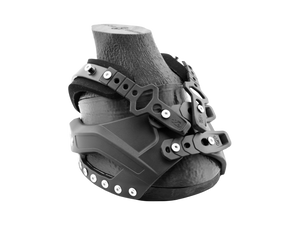
A professionally applied glue-on shoe generally lasts for a normal trim interval of around 6–8 weeks. The Goodsmith glue-on shoe has a modular design and can be individually adapted to the hoof, for example with additional side clips for more lateral stability. It is LPO-compliant and can therefore also be used in competitive sport. It is applied by a farrier or a trained person.

Strengths of the glue-on shoe:
- continuous protection without nails,
- movement close to that of a barefoot hoof, supports the hoof mechanism
- suitable for sport and rehab.
- can also be used when nailing is not possible, for example with a broken-out hoof wall
- can usually be reused several times
Limitations of the glue-on shoe:
- material and application require experience; fitting belongs in expert hands
- plastic has lower abrasion resistance than steel – depending on the horse, its way of moving, the ground and the use, the plastic can wear faster than steel


What is a hoof boot?
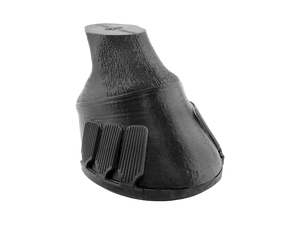
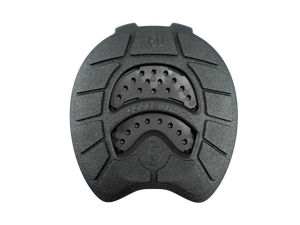
A hoof boot is a temporary hoof protection that is put on and taken off as needed and only protects the hoof during individual load phases. It is usually fastened around the hoof and pastern with straps and tabs. In between, the horse remains barefoot. This allows the hoof mechanism and blood circulation to work undisturbed for most of the day. At Goodsmith, the glue-on shoe and the hoof boot are based on the same base plate, which is designed to be close to barefoot and therefore lets the hoof mechanism work undisturbed with hoof boots as well.

Fit is crucial: as with humans, not every shoe fits every hoof shape, because the hoof is a three-dimensional, living organ that changes over time. The Goodsmith hoof boot is custom-made for each individual horse and therefore fits your horse's hoof shape perfectly. A hoof boot is explicitly not a permanent replacement and should not be worn around the clock.

Strengths of the hoof boot:
- maximum flexibility – protection exactly when the horse needs it.
- the hoof remains barefoot between uses
- very good shock absorption during load peaks.
Limitations of the hoof boot:
- has to be put on and taken off every day
- no 24/7 protection

Hoof boots or glue-on shoes: the differences at a glance
| Criterion | Glue-on shoe | Hoof boot |
|---|---|---|
| How it is worn | Permanently on the hoof, approx. 6–8 weeks (one trim interval) | Temporary – only put on and taken off when needed |
| Attachment | Nail-free, glued to the hoof wall | Straps and tabs around the hoof and pastern |
| Hoof mechanism | Only slightly restricted, but the effect is permanent | Fully preserved during the barefoot phases |
| Shock absorption | Similar to the unshod hoof | at Goodsmith similar to the glue-on shoe thanks to the same base plate |
| Typical uses | Sport, high abrasion, rehab, continuous load | Hacks, trail riding, transition, load peaks |
| Fitting | By a farrier or trained person | Can be done yourself after fitting by a professional |
| Everyday use | Once applied, low-maintenance until the next change | Putting on and taking off every day, checking the fit |
| Limitations | Higher abrasion on stony ground; professional application required | not intended for 24/7 use |
When is a glue-on shoe the right choice?
A glue-on shoe is the right option when protection is needed continuously.
Typical situations:
- Regular training or competitive sport with high loads.
- Hard or highly abrasive ground on which wear exceeds horn growth.
- Rehab and load management, for example with a broken-out hoof wall when nailing is not possible.
- A wish for protection close to barefoot that does not have to be put on and taken off every day.

When is a hoof boot the right choice?
A hoof boot is the right option if your horse generally copes well barefoot and only needs protection now and then:
- The horse goes barefoot in the stable and paddock without any problems and is only tender under saddle.
- Hacks over stony ground, trail rides or individual load peaks.
- A transition phase when switching from shoes to barefoot.

What about cost, durability & effort?
A glue-on shoe is usually priced moderately above a classic steel shoe – the difference arises mainly from the greater effort involved in fitting and labour, not from the material alone. It lasts around 6–8 weeks and is then low-maintenance in everyday use until the next change. At Goodsmith, the initial investment is put further into perspective because the components can usually be reused for 2–3 shoeing intervals.
A hoof boot is a one-off purchase with a long service life, but in return it demands everyday discipline: reliably putting it on and taking it off and regularly checking the fit and how it sits.
Conclusion
There is no blanket answer to the question "hoof boots or glue-on shoes" – and that is a good thing. Both are horse-friendly, nail-free hoof protection that is gentle on the hoof mechanism. The glue-on shoe is the choice for continuous protection, the hoof boot for flexible, temporary load peaks. What matters is your horse's use, ground and hoof health.
So the question is not "Which system is better?", but "Which system suits this hoof, under these conditions, for this purpose?" The safest way to make the decision is together with a professional who assesses the hoof.
Next step: find a trained professional near you via the Goodsmith
FAQ
Which is better – hoof boots or glue-on shoes?
Neither is fundamentally better. A glue-on shoe is suitable for continuous protection (sport, high abrasion, rehab), a hoof boot for flexible, temporary protection for horses that otherwise go barefoot. The choice depends on use, ground and hoof health.
How long does a glue-on shoe last?
A professionally applied glue-on shoe lasts around 6–8 weeks – which corresponds to a normal trim interval.
Can hoof boots be left on the horse permanently?
No. Hoof boots are intended for temporary use and should not be worn around the clock. Between uses, the hoof remains barefoot
Which hoof protection absorbs shock better?
In the measurements taken by Vetmeduni Wien, the hoof boot showed the highest shock absorption, while the glue-on shoe came close to the barefoot hoof. Both absorbed shock significantly better than a horseshoe.
Who applies a glue-on shoe?
Application requires experience and belongs in the hands of a farrier or a trained person. You can find professionals near you via the Goodsmith hoof expert map.
