 Find a hoof expert
 Become a partner

Finding the right hoof boot
Why one-size-fits-all fails on the hoof — and how individual fit works.
Table of contents

Hoof boots are temporary hoof protection systems for horses. Their quality is not defined by material or workmanship alone, but by how well they match the individual hoof shape, preserve the hoof mechanism under load and perform in real-world use. Whether a hoof boot works is therefore always context-dependent and stands or falls with fit.
Anyone looking into hoof protection quickly comes across hoof boots as a flexible alternative. In practice, however, a problem often appears: the boot fits according to the chart, but loses its hold in the terrain or causes pressure points.
This is rarely down to the hoof boot concept itself. It is due to the assumption that an industrial standard shape can do justice to the individual dynamics of a hoof. A hoof is not a static object, but a functional organ.
In this article you will learn:
-
why hoof boots so often do not fit and why your horse's hoof shape is more than length and width
-
what fit on the hoof actually means technically and why the hoof mechanism plays a central role
-
how to measure your horse's hoof correctly and where the limits of a size chart lie
-
what to look for when making your choice material, closure and intended use, assessed against clear criteria
-
why a modular, adjustable hoof boot is in many cases the more sensible solution from a technical standpoint
Why hoof boots so often do not fit – the underlying problem
The hoof as a three-dimensional organ — why two measurements are not enough
To be able to assess correct hoof boot fit sensibly, we first need to clarify what the hoof actually is.
The hoof is not a passive contact surface and not a standardised component. It is a functional organ in the horse's locomotor system. At the same time, it handles:
-
load absorption and load distribution
-
shock absorption
-
stabilisation and balance
-
transfer of forces into tendons, joints and muscles
The shape of the hoof capsule is influenced by genetics, body mass, housing conditions, trimming history and use. Even in horses of the same breed and comparable size, the proportions of the hoof vary considerably. Width is still the most stable parameter. Heel height, toe angle, wall thickness and sole concavity often differ significantly — even between the front and hind hooves of the same horse.
The key point is:
The hoof is a three-dimensional, living organ with individual geometry.
A size chart that only takes length and width into account and derives a fixed standard size from them only captures the two-dimensional projection of this three-dimensional reality.
This is the reason why correct fit on a hoof boot fundamentally works differently than on a human shoe.
What correct fit on the hoof really means
Hoof boot fit is often reduced to the question: what size do I need? That falls short.
Movement at the hoof takes place under load , not in a static state. As the hoof lands, it deforms three-dimensionally: it widens at the back, the sole bulges slightly downward, and the hoof wall in the heel area moves outward. This dynamic behaviour is called the hoof mechanism .
The hoof mechanism is essential for:
-
shock absorption
-
blood flow in the hoof
-
load distribution throughout the locomotor system
A hoof boot that fits while standing but blocks the natural deformation of the hoof under load restricts hoof mechanics. At a gallop, enormous forces act briefly on a single hoof. The hoof boot must be able to work with these forces — not against them.
Correct fit therefore means:
A hoof boot must sit tightly enough not to slip and at the same time provide enough room so the hoof mechanism is not restricted. It must not only work standing still, but prove itself in motion.
For the assessment of hoof protection in general, the following criteria apply, among others:
- preservation of the hoof mechanism,
- adjustability to individual anatomy and change,
- behaviour under real load
- and everyday practicality.


Why standard sizes so often fail
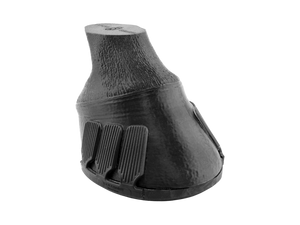
Most hoof boots on the market are produced in fixed sizes. The logic: measure hoof width and length, look it up in the size chart, order.
The problem is not the chart itself. It is a sensible starting point. The problem is what it does not capture.
Two horses with an identical hoof width of 130 mm can have completely different shapes. One has steep, short heels and a round sole shape. The other has flat, underrun heel areas and an oval sole. Both end up in the same row of the size chart in the same size — but no standard boot will fit both equally well.
The basic hoof shape also plays a role: in oval or narrow hooves, width is often the decisive parameter for correct fit. In rather round hooves, length tends to become the limiting factor. Anyone who only looks at one of the two values is more likely to choose a size that does not match in the other dimension.
On top of that: The hoof shape is not static.
The hoof grows, is trimmed, reacts to housing conditions and changes with use. What fits today may sit differently in eight weeks. This is particularly clear in horses being transitioned from shoes to barefoot — in the first few months, the shape often changes considerably. Hoof care practitioners report from the field that some horses need two or three different sizes during the transition phase until the hoof shape has stabilised.
Even with stable trimming there are changes: in an open barn the natural wear leads to different proportions than in box housing. In summer the horn grows faster than in winter, and directly after trimming the hoof sits differently in the shell than three weeks later, once new horn has grown in.

That means:
Standard sizes work well enough for many horses. But they reach their limits as soon as the shape deviates from the norm, changes, or does not fit into any standard shell.
Step by step: measuring the hoof correctly


Even if measurements alone do not guarantee correct fit — measuring correctly is still the first and most important step. Errors in measurement multiply.
Measure on the lifted hoof. Not from a paper imprint or a grease print on the ground. These methods deliver inaccurate values because the imprint does not correctly reproduce the three-dimensional shape. The best and most precise method is to measure directly on the lifted hoof with a ruler or folding rule.
Measure each hoof individually. Hooves are often different sizes — even on the same horse. Front and hind hooves differ in size and shape, and the hooves on the right and left side are rarely identical. Every single hoof needs its own measurement in order to determine the right size.
Length: from the tip of the toe to the widest point of the frog. Not to the rear end. Only in this way are underrun heels correctly taken into account. In very few cases the rear end and the widest point of the frog lie on one line.
Width: at the widest point of the hoof. Place the folding rule where the hoof is actually widest — usually about midway between toe and heel.
Do not include the bulbs. The bulbs are usually not included in the length measurement — unless the manufacturer explicitly states otherwise in its measurement guide.
Timing: Ideally take the measurement around two weeks after the last trimming appointment.
What matters is:
The right size is decisive for comfort and function of the hoof boot under load. But these measurements are a starting point for size selection — nothing more. Whether the hoof boot actually fits only shows when fitted on the hoof and in motion.
What to look for when choosing: material, closure, intended use
Knowing the right size is the first step. The second is choosing the right system. Not every model suits every situation — and the differences between hoof boots are not only about looks.
Hoof mechanism and material
Hoof boots are typically made of plastic or polymer compounds. What is decisive is not only the durability of the material, but its behaviour under load.
As described in the first section: the hoof deforms three-dimensionally under load. A hoof boot made of rigid material that tightly encloses the capsule can restrict this deformation. This is the reason why rigid one-size shells do not work for some horses — not because the material is poor, but because it is designed for a static shape, not for a dynamic organ.
Central question for material selection:
Does the hoof boot allow the hoof mechanism — or does it block it?
A movement-friendly material that deforms minimally under load allows a function closer to barefoot than a rigid system. This is not a quality judgement on individual materials — it is a functional criterion.
How to tell that a hoof boot does not fit correctly
Not every fit error shows up immediately. Some problems only become visible after minutes or kilometres:
-
The hoof boot can be turned by hand on the hoof — it sits too loosely
-
The horse changes its rhythm, takes shorter or more irregular steps — possible pressure point at toe or heels, or unfavourable influence on breakover
-
Rub marks at the coronet or bulbs after the ride
-
The boot is hard to remove after wear because it has pressed into the hoof wall
A hoof boot that does not fit correctly is not automatically a bad product. It simply does not suit this hoof. The hoof shape — not the boot quality — is in most cases the limiting factor.
Closure and fastening
Hoof boots differ fundamentally in their fastening:
-
Shell systems with hook-and-loop or cable — quick to apply, but prone to slipping with a tight gait or strong load
-
Buckle systems — stable hold, possible rubbing risk on long rides
-
Strap systems with several fixation points — distribute hold across several points on the hoof and pastern, which stabilises fit in motion
The choice depends on the intended use and on handling. For short rides on stable paths, a simple system is often enough. For longer rides, uneven terrain or horses with a tight gait, a more stable fastening is needed.

Intended use
Not every hoof boot suits every purpose:
-
Rides on gravel paths: good sole protection, grippy sole, easy handling
-
Longer trail rides: low rub potential, stable fit over hours
-
Rehabilitation: padding options, room for inserts, always in coordination with vet and hoof care practitioner
-
Open barn (temporary): no protruding parts that could get caught on fences or waterers; in mud and slush look for a model that is easy to clean
Hoof boots can also be used for chronic pain, hoof sensitivity or rehabilitation from injuries. In such cases the hoof boot is a tool in load management — not a cure. Use is always coordinated with vet and hoof care practitioner.

Why a modular hoof boot is the solution

The conventional approach to hoof boots works like this: the manufacturer produces shells in fixed sizes. Owners look for the size that best matches the hoof.
With asymmetric hooves, unusual proportions or horses in a transition phase, this principle reaches its limits. The hoof does not fit into any standard shell — or only with compromises that show up under load as pressure points, instability or restricted hoof mechanism.
A different approach turns the logic around:
Instead of adapting the hoof to the boot, the boot is adapted to the hoof.
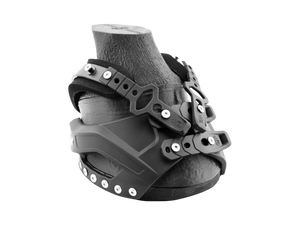
The Goodsmith Hufschuh-Kit follows this principle. It is not a finished hoof boot, but a modular system made of individual components:
-
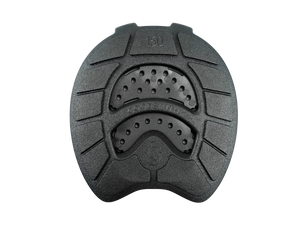
Base plate — adjusted to the individual sole shape
-
Side parts — adapt to the hoof wall
-
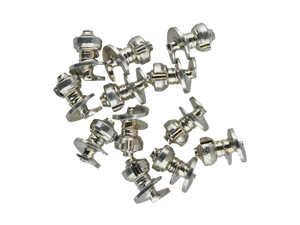
Strap system (front, instep, heel, pastern strap) — distributes hold across several fixation points
-
Optional: gaiter and insole pads for additional bulb protection
The kit is individually fitted to the single hoof by the farrier or hoof care practitioner.
No one-size shell. The components are combined and adjusted until the fit matches the individual hoof — including angle, side wall shape and sole profile.
Re-adjustable. Thanks to the modular structure, the boot can be adjusted to changed hoof conditions without having to be completely replaced.
Movement-friendly. The system is designed to preserve the hoof mechanism. The base plate gives the hoof the room to deform naturally under load.
Temporary use. The Goodsmith hoof boot is designed for temporary use — for rides, competitions or short-term rehab phases. Not for 24/7 wear.
The role of hoof experts
Even an adjustable system does not replace expert advice. Adjustment should be carried out by an experienced hoof care practitioner or farrier who can assess the hoof as a whole: hoof shape from below, geometry of the heel area, gait and intended use.

Conclusion
Hoof boots are a sensible tool in temporary hoof protection — when the fit is right.
Correct fit means more than the right row in a size chart. It means:
-
a boot that matches the individual three-dimensional hoof shape
-
that does not restrict the hoof mechanism under load
-
that suits the intended use
-
and that works under real-world conditions
Standard sizes can deliver this for many horses — but not for all. Those struggling with fit problems usually do not fail at their own measuring technique, but at the limits of the one-size-fits-all principle.
A modular, adjustable boot can be a context-dependent alternative here. The most important step is not the purchase, but the expert advice on what suits the horse best.
The question is not: “Which hoof boot is the best?” But: “Which boot fits this hoof, under these conditions, for this purpose?”

FAQ
How do I correctly measure my horse's hoof boot size?
On the lifted hoof, with a ruler or folding rule. Measure hoof width at the widest point, hoof length from the tip of the toe to the widest point of the frog — not to the end of the heels. Measure all four hooves individually, ideally 14 days after trimming. The bulbs are usually not included.
Why does my hoof boot not fit despite correct measurements?
Size charts for standard hoof boots only capture length and width — but the hoof is a three-dimensional organ. Heel height, toe angle, side wall asymmetry and sole concavity considerably influence fit. A boot that should fit according to the chart can still press, wobble or disturb breakover.
What is the advantage of a modular hoof boot kit?
A modular boot is assembled individually from separate components and adapted to the hoof — instead of forcing the hoof into a standard shell. This makes a more precise fit possible even with unusual hoof shapes and allows re-adjustment as the hoof changes, without having to replace the entire hoof boot.
