What Makes Good Hoof Protection?
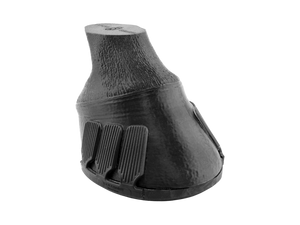
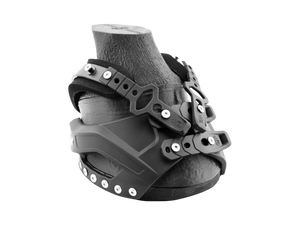
Everything used to be simple: horses were either kept barefoot or shod with steel horseshoes. But times have changed: on the one hand, the requirements for hoof protection have changed due to the changed use of our horses and changed housing conditions. And on the other hand, new developments - particularly in plastics technology - have made ever new forms of hoof protection possible. There are now a multitude of products on the market and as a horse owner you are often spoiled for choice: iron horseshoes, plastic horseshoes, glued hoof protection (plate + straps), glued hoof protection (shell), hoof shoe or Velcro protection?!
When in doubt, the choice should of course always be made by a professional on site - not every hoof protection is suitable for every horse in every situation. But as a horse owner, you should also be familiar with the advantages and disadvantages of the individual variants, because you know your horse and its problems best. And, you have the necessary tools to be able to exchange ideas competently with your hoof carer.
Therefore, we want to explain to you here which requirements modern hoof protection generally has to meet. Exceptions are of course veterinary measures (e.g. in the case of a hoof bone fracture)!

Horse requirements
Of course, the most important thing is that the hoof protection serves your horse. Therefore, we first want to clarify the requirements from the point of view of horse health before we briefly show what other criteria there are from the point of view of the horse owner and farrier.
Customizability
No horse's hoof is like the other. Therefore, the hoof protection must also be adaptable to the different hoof shapes. With glued hoof protection, which consists of two parts (i.e. no fixed shell, but separate base plate and straps), this is usually the case without any problems and some hoof shoes can also be adapted to the hoof to a certain extent.
If the hoof protection is difficult or impossible to adjust due to its construction (e.g. fixed shells) or its material (iron, etc.), a suitable shape for the hoof must still be found. Unfortunately, sometimes the opposite approach can still be found: the shape of the hoof is adapted to the hoof protection. However, this has serious disadvantages: since only the outer hoof shape (i.e. the walls) are adapted to the hoof protection, the hoof capsule then no longer fits the "inner workings" of the hoof. For example, the hoof wall may have been rasped too thin in some places and is then no longer sufficiently stable.

Flexibility
Good hoof protection should be stretchable on the one hand and twistable on the other. Why? Quite simply: this is the only way for the hoof mechanism to function optimally. The hoof mechanism is responsible for a number of important functions; We have described which (and why) in more detail here: Hoof mechanism
The elasticity of the hoof protection is not only important for the hoof mechanism, but also for correct growth. As you have probably already noticed, the hoof walls are not straight to the ground, but at an angle. That is, the hoof is wider at the bottom (ground) than at the top of the coronet. The hoof therefore grows conically downwards, at around 1 cm per month.During this time the hoof grows up to 8mm in width! However, if the hoof capsule is now fixed at a certain size at the lower edge by the hoof protection, the hoof can only grow straight down instead. The consequences of this are serious: the hoof is constricted and therefore smaller. The sole can no longer stretch over its full width and instead begins to curve inwards. This means: the sole develops an unnaturally high arch, which presses inwards on the coffin bone. This is then called “sole constraint” and can be extremely painful for the horse.
So it is extremely important that a good hoof protection has enough elasticity to allow for lateral expansion of the hoof as well as to allow for torsion in the ball area and the hoof mechanism.
Here is another interesting video about the hoof mechanism: Video

Damping
Every time your horse lands its hoof on the ground, impact energy is created. In nature, the horse walks barefoot over soft ground; under these conditions, the hoof absorbs some of this energy and thus provides cushioning (we explained this in more detail in the article on the hoof mechanism). If your horse therefore has healthy bare feet and also walks over soft ground, then it is well equipped to deal with these forces without any problems.
But here's the catch: many horses walk on very unnatural, often unyielding ground, e.g. B. concrete, asphalt or compacted natural soil (particularly paved paddocks without sufficient footing). The natural cushioning mechanisms of the horse's leg are not designed for such floors and early signs of wear and tear on the joints (arthrosis, etc.) can be the result. Therefore, if your horse moves a lot on very hard and unyielding ground, then the hoof protection should provide additional cushioning, not only to protect the hoof capsule from abrasion, but also to protect the joints from damage.
Of course, the same also applies if the hoof already has health problems and the natural cushioning mechanisms no longer function adequately: worn joints, little arch or a stunted hoof frog are just a few of the numerous examples of when additional "shock absorption" is provided by the hoof protection must be.
Under no circumstances should the hoof protection trigger additional forces when it hits the ground! This means that if, for example, hard metal hits hard ground with momentum, it triggers micro-vibrations. These then have to be absorbed by the hoof or the horse's leg and damage the small toe joints in particular. This is also the explanation why carriage horses are particularly often affected by shell (= hoof and coronary arthrosis).

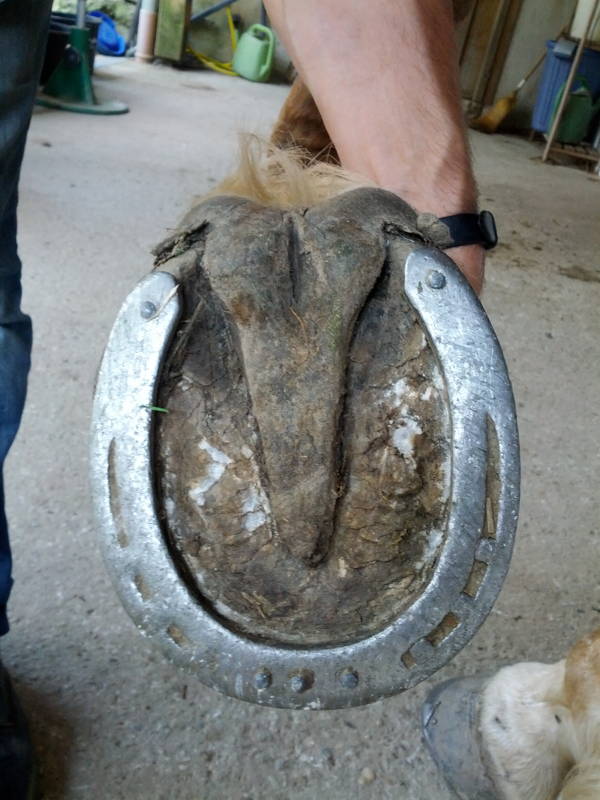
Image: Old horseshoe for shock absorption
weight
Another important factor in hoof health is the weight of the hoof protector. This applies in particular to the joints, because: every time your horse lifts a leg and leads it forward, centrifugal forces act on the horse's leg. To do this, you have to imagine that the horse's leg consists of a "chain" with individual rigid elements (the bones) which are held together by flexible connections (the tendons and ligaments).If your horse now puts one foot forward with a swing, the more swing the movement has and the higher the weight that hangs at the end of this “chain”, the higher the forces pull on these flexible connections. So if your horse gallops, for example, the power increases the weight of the hoofguard at the end of his leg to a multiple of its original weight.
On the one hand, this naturally puts excessive strain on the tendons and ligaments. On the other hand, the type of attachment of the hoof protection also comes into play. With a hoof shoe that rests against the hoof wall and encloses the ball of the foot, this "balancing weight" is distributed over a relatively large area and therefore puts relatively little strain on the individual areas. If, on the other hand, a hoof protection is only attached to the hoof wall with a handful of nails, the centrifugal force is concentrated on a very small area and represents a point load for the hoof wall.
To give you a feeling for the weight of different hoof protection variants, we have put together an example list here:
- normal horseshoe: ~550g
- Steel horseshoe with plastic coating: ~350g
- Aluminum horseshoe: ~120g
- decal (plastic shell): ~200g
- decal (base plate + tabs): ~210g
- hoof shoe: from 250g
The exact values are of course always dependent on the size and the respective manufacturer and should therefore only be regarded as average values. Depending on the type of attachment, nails or glue are also added as weight.
The more your horse moves in faster gaits and therefore its legs are exposed to high centrifugal forces, the more important it is that the hoof protection is very light and is mounted on the largest possible area on the hoof.
Beam support
A very important requirement for good hoof protection, which is often given too little attention, is the flexible support of the frog. Why? It's simple: the hoof frog is naturally built to have ground contact in the back third. It not only fulfills an important cushioning function, but also helps with load distribution. The frog thus relieves the heel walls, which would otherwise be exposed to too much pressure and thus become thinner and weaker. This can go so far that the heel walls push up and thereby press the associated bars into the hoof. The result of this cramped heel situation is often the dreaded "navicular syndrome".
In addition to relieving the pressure on the heel walls, the frog support is particularly important for the hoof mechanism already mentioned: when the rear area of the frog is loaded, it pushes the balls apart via the frog and ball padding and thus ensures that the hoof capsule expands widens in the back.
However, if the frog "hangs in the air" and has no contact with the ground, a vicious circle can quickly form: due to the lack of counter-pressure, the heel pads are squeezed together. This impedes blood circulation in the rear part of the hoof and the frog corium is less well supplied. Eventually, due to the lack of stimulation and nutrient supply, less frog horn is produced and the frog atrophies. Frequently, thrush then develops at the same time, because the contusion creates deep and narrow sulcus furrows in which manure stays particularly well and bacteria thrive in the absence of air.
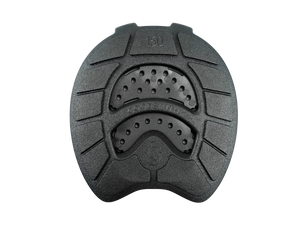
Therefore, it is extremely important that the hoof protection provides sufficient frog support. If the frog has already degenerated, additional insoles often help to put ground pressure on the frog again and stimulate its growth.
Influencing the natural movement
Sure, any unnatural material on the hoof can affect the individual movement of your horse. Sometimes this is even desired, e.g. B. in the area of gaited horses. Most of the time you don't want that, because in order to keep your horse healthy in the long term, the natural gait mechanics should not be unnaturally disturbed. All movements that your horse does not show naturally (e.g. because it is not or only poorly able to do so due to its structure) should not be artificially generated even with hoof protection, as this would otherwise lead to excessive wear and tear on the musculoskeletal system .
In order to preserve your horse's natural movements, it is therefore important, for example, that the roll-off point of the hoof protection can be reset. This corresponds to the horse's natural stepping motion, allowing it to roll effortlessly over the toe. If it cannot do this, there is increased traction on the hoof capsule with each step, allowing the bars to lever into the hoof and press on the navicular complex. The result is very often that traditional costumes are worn underneath.
If the breakover point of the hoof protection cannot be reset to the physiologically correct position, the foot also stays on the ground longer. If the front hooves are affected, it often happens that the horses step into the ball of their heels with their hindquarters or develop an unnatural movement pattern.
Furthermore, the material of the hoof protection can influence the course of movement. This often depends on the respective surface: metal hoof protection slips more on slippery floors (concrete, asphalt) than a bare hoof would. Plastic that is too soft, on the other hand, brakes an unnatural amount and thus represents an additional strain on the joints. The optimum is therefore somewhere in the middle: plastic with a hardness similar to that of a bare hoof.
The more your horse rides on slippery surfaces, the more you should pay attention to the right material properties when it comes to hoof protection.
A good hoof protection should also not cause stumbling. In principle, stumbling can of course have a variety of causes (e.g. tension in the back), but sometimes it is also triggered by unsuitable hoof protection. For example, clumsy hoof boots can lead to stumbling, especially in horses that tend to show little leg action. On the other hand, a hoof protection that is too rigid can also be to blame: the more the hoof mechanism is obstructed, the less the horse feels in its hooves. However, if the horse no longer feels its feet well, it will stumble much more often. A corresponding flexibility of the hoof protection is therefore also important for the preservation of the natural movement pattern and footing behavior.
Hygiene
The last point we would like to mention here is the hygiene aspect. Good hoof protection should either prevent contamination of the hoof (e.g. by sealing off critical areas) or allow the hoof to be cleaned properly
Unfortunately, this point in particular is a disadvantage with many hoof protection variants. Because as soon as the hoof is protected from excessive abrasion, more or less many areas of the hoof are covered.If the horse is kept in a clean environment, this is usually not a problem. If, on the other hand, the horse stands for hours in urine-soaked mud, it quickly begins to rot under most hoof protection options.
In general, however, the following applies: the more the hoof can live out its natural range of motion (hoof mechanism), the more resistant the individual structures are and therefore tend to cope better with such loads.
But suitable hoof protection also means protecting the hoof from mechanical damage. This means that existing damage (e.g. erupting walls) is not aggravated and of course that this must not be caused by the hoof protection under any circumstances - because then the sense of "protection" would lead ad absurdum. This also applies to the attachment and removal of the hoof protection: if, for example, holes are made in the hoof wall to attach the protection, this not only damages the stability of the horn capsule, but also provides entry points for bacteria and fungi.
Requirements from a human perspective
In addition to the requirements mentioned so far from the point of view of hoof health, there are other criteria that good hoof protection must meet from the point of view of us humans.
Durability
Good hoof protection should reliably protect the hoof from excessive wear between trimmings. With permanent hoof protection (shoes, stickers or 24-hour hoof shoes), abrasion is completely prevented and the interval between two treatments should therefore not be longer than 4-6 weeks, otherwise the regrowing hoof material can have a negative effect on the hoof. This is therefore also the period that a permanent hoof protection should normally endure on the hoof, regardless of the weather or use. Of course, it can happen again and again that a horse slips off the hoof protection itself - but this should be the exception for a horse with an average build and normal gait.
The situation is different with hoof protection that is removable, i.e. with hoof shoes and hoof protection that can be hooked on. Here, too, there are individual models that are designed for permanent use (e.g. patient shoes), but as a rule most variants are made so that they can be put on and taken off again by the hour or day if necessary. Since these types of hoof protection are not attached to the hoof with a fixed connection, the requirement for durability is different here: the temporary connection (i.e. the Velcro or buckle) must remain on the horse's hoof without slipping for the period of wear. This means that the hoof protection must not simply say goodbye or twist on the hoof, even when used for sport. Individual adaptability is the best guarantee for meeting this requirement.
The durability does not only refer to the flawless staying on the horse's hoof, but also to the material fatigue. That means: how much does the material wear down when the hoof protection is worn by your horse?
In addition to the weight of your horse, the usage is also decisive for the "mileage" of the hoof protection. In other words, how often is the hoof protection used in which gait? And of course it also depends a lot on the terrain on which your horse runs with it.If the hoof protection is primarily needed when riding out on hard gravel paths or for driving on asphalt (and your horse may also live in a playful herd in the active stable), the abrasion is of course correspondingly higher than if the horse was only used between a soft chip box and carpet shreds. Hall floor changes
Basically, the harder the material, the less abrasion. However, since extremely hard material (metal) has some disadvantages (see previous points), many manufacturers try to find a good middle ground here. The supporting edge of the hoof protection is often made of a different material (or reinforced with a harder material) than the remaining (sole) area of the hoof protection. Or ultra-light but durable fibers (mostly carbon fibers) are incorporated, increasing resilience without sacrificing flexibility.
In case of doubt, however, compromises should be made in terms of durability rather than flexibility of the material - for the sake of your horse's health.
Handling
For us humans, handling is also an important point in modern hoof protection. This means on the one hand the attachment and removal, as well as the handling in everyday life. This also includes, for example, the possibility of being able to attach anti-skid (cleats) or protection against cleats in winter.
Ideally, the owner should also be able to fit and remove the hoof protection (after appropriate instruction from a professional). Because it can happen again and again that the hoof protection has to be removed quickly, for example due to an illness (e.g. hoof abscess) or a visit to the vet (for X-rays or other examinations). Or because the horse is being switched to barefoot and the hoof protection should therefore not remain on the hoof for the entire interval between trimmings. In such situations, it is often useful if the owner can either attach the hoof protection himself 1-2 weeks after the trimming or remove it himself 1-2 weeks before the next trimming.
In the case of a removable hoof protection, it is of course also important that the handling with frequent putting on and taking off can be carried out as uncomplicatedly and error-free as possible and that this does not result in excessive additional effort.
Cost
Quality has its price. This also applies to modern hoof protection: in recent years there have been enormously great developments in plastics technology, which of course also have to be paid for first. Nevertheless, good hoof protection must not be a question of money: good hoof protection must be affordable so that as many horses as possible can benefit from it.
However, the total costs are influenced by several factors that must be considered in a differentiated manner:
- Material costs (initial purchase and consumables)
- Wear and tear or reusability of the material
- working hours
Many a hoof protection is very cheap when initially purchased, but can only be used once and must be fitted by a professional with the corresponding amount of work. This puts the cheap acquisition costs back into perspective over time.
Other hoof protection variants, on the other hand, are quite expensive to buy, but can be used several times or over a long period of time and can be adjusted and attached by the owner himself. This puts the acquisition costs into perspective over time.
If you compare the costs of different hoof protection options, you should always include all three factors and calculate the total costs for a year, for example.
Environmental impact or ecological compatibility
As horse owners, we need to be aware of the impact our modern horse husbandry has on the environment. The number of horses in many (European) countries has been at a stable all-time high in recent years, but tending to increase; In Germany alone, around 1.3 million horses were counted in 2019. And in this mass, it naturally makes a difference how we keep our horses, feed them and what products we equip them with.
All hoof protection variants have a different “sticking point”: in the case of plastic variants, it is often the plastic itself that shows a poor ecological balance. The toxins in the production (release agent) or in the adhesives should also be taken into account. Here it is important to note the country in which the plastic protection is manufactured: in European countries there are strict legal requirements which at least prevent these substances from escaping into the environment.
It is also often heard that the plastic rubs off during use and leaves microplastics in the ground. Yes, in small amounts that is correct. Your sneakers and bike tire do the same, though.
With metal hoof protection, on the other hand, no environmentally harmful material is required for assembly. But here, too, the hoof protection rubs off over time and the rubbed-off material disappears into the environment. In addition, the mining and smelting of the metals must not be left out of the eco-balance. For example, bauxite is the starting material for aluminum production and large areas of the rainforest are cleared for this. Of course, the metal demand for horseshoes is very small compared to the rest of the global comparison - but those who are concerned about the environment should not ignore these aspects.
All in all, no hoof protection is really environmentally friendly - unfortunately. However, the negative effects can be reduced if the hoof protection can be used for a long time. Material wear and tear and reusability therefore also play an important role here.
Conclusion
As you've probably discovered from reading, each hoof protector has its pros and cons, and some of these are down to your individual judgment of how important they are to you (e.g., handling and protecting the environment).
But there are a few universal criteria that good hoof protection must meet so that it can bring about a lasting improvement for your horse's hooves and not replace one deficiency with another.
To give you a better overview of all this information, we have summarized the most important factors for you here, including a rough indication of which hoof protection meets which requirement and how well:
| Permanent hoof protection | Removable hoof protection | ||||||||||
| Iron fitting | Plastic fitting | Glued hoof protection (plate + tabs) | Glued hoof protection (shell) | Hoof boots / Velcro protection | |||||||
| Customizability | ✔️ | ✔️ | ✔️ | ❌ | depending on model | ||||||
| Flexibility | ❌ | partially | ✔️ | depending on model | ✔️ | ||||||
| weight | approx. 400g | approx. 350g | approx. 200g | approx. 200g | > 250g | ||||||
| Damping | ❌ | partly | ✔️ | ✔️ | ✔️ | ||||||
| Beam support | only with insert | ✔️ | ✔️ | ✔️ | ✔️ | ||||||
| Hoof horn damage | high | high | minimal | medium | not at all | ||||||
| Cleaning the hoof | good | medium | medium | medium | very good | ||||||
| Durability | very good | very good | good | good | good (fit important) | ||||||
| Cost | very low | low | medium | medium | initial: high long-term: low | ||||||
Author: Nathalie Kurz www.mein-leben-ist-ein-ponyhof.at
Sources:
-
http://hufschule.at/wp-content/uploads/2019/11/GesellschaftHufgesundheit_Klebebeschlag.pdf
-
https://www.pferd-aktuell.de/deutsche-reiterliche-vereinigung/zahlen--fakten