 Find a hoof expert
 Become a partner


What is the hoof mechanism in horses?

The hoof mechanism describes the natural elastic movement of the horse's hoof with every step. As the hoof lands, the hoof capsule deforms slightly, the heels and frog adapt to the ground, and elastic structures in the rear of the hoof absorb part of the load. As the hoof leaves the ground, it returns to its original shape.
This biomechanical movement serves several central functions: it acts as a shock absorber for joints and tendons, supports blood circulation in the horse's leg, distributes forces evenly across the hoof and enables the horse to adapt to different ground conditions.
An intact hoof mechanism is therefore an important foundation for healthy movement, stable hooves and long-term resilience of the horse. Various factors such as hoof trimming, movement, ground, horn quality and the type of hoof protection can influence how freely the hoof mechanism can work.

The hoof mechanism in horses: function, importance and influencing factors
The hoof mechanism is one of the most important biomechanical functions of the horse's hoof. But what exactly happens in the hoof with every step – and why is it so crucial for your horse's health? In this article you will learn everything about the evolution of the horse's hoof, the function of the hoof mechanism and the factors that influence it.
From multi-toed to single-toed: how the horse's hoof evolved
The horse's hoof as we know it today is the result of millions of years of evolution. The earliest known ancestors of the modern horse – such as the fox-sized Hyracotherium (also called Eohippus) – still had several toes. Over millions of years, these animals adapted to open grasslands where speed and endurance determined survival. The lateral toes gradually receded until only a single middle toe remained – today's terminal toe organ that we know as the hoof.
This remaining toe developed into a robust structure encased in a hard horn capsule, capable of bearing the horse's entire body weight. At the same time, it remained surprisingly elastic – and it is precisely this combination of stability and mobility that forms the basis of the hoof mechanism.

What is the hoof mechanism in horses?
Although a horse's hoof appears hard and rigid at first glance, it is in fact remarkably mobile. Considerable forces act on the hoof with every step – and the hoof capsule responds: heels, sole and frog adapt to the ground, certain structures sink minimally, and as the hoof leaves the ground, everything returns elastically to its original shape.
This continuous alternating movement between expansion and contraction is not a random side effect – it is a central function of hoof mechanics and fulfils several vital tasks for the horse.
The hoof mechanism comprises two directions of movement:
The horizontal component concerns the lateral widening and contraction of the hoof capsule, especially in the heel area. The vertical component describes the hoof's ability to adapt to uneven ground and to compensate for slight torsional movements.
Important: the term "hoof mechanism" is a simplified model. The actual biomechanics of the hoof are considerably more complex – numerous structures, forces and movement sequences interact in a way that a simple schema can only approximately describe. For understanding the basic principles, however, the model is extremely helpful.
An intact hoof mechanism is essential for the longevity and pain-free movement of the horse – because a hoof that loses its natural elasticity can no longer fully perform its protective and supply functions.
How does the hoof mechanism work? The biomechanics in detail
To fully understand the hoof mechanism, it is worth taking a look at the structures involved and how they work together.
The structures involved
The hoof mechanism arises from the interaction of several anatomical components: the hoof wall, sole, frog, heels, bulbs, digital cushion and the suspensory apparatus of the coffin bone in the laminar corium. Each of these structures contributes to the overall elastic function.
Deformation on landing
When the horse's hoof touches the ground, several biomechanical processes occur simultaneously: the heels move slightly apart, the hoof capsule expands minimally at the rear, the sole flattens slightly, and the coffin bone descends minimally within the physiological range. At the same time, elastic structures in the rear of the hoof are compressed.
These movements are small, but functionally absolutely decisive. Through the interplay of body weight from above and counter-pressure from the ground below, blood is pressed more strongly into the corium of the hoof – an effect that plays a central role in the blood supply of the entire hoof.
Return to shape on lift-off
As soon as the leg is unloaded, the hoof capsule releases the stored energy and returns to its resting shape. This springy alternation between loading and unloading works like the body's own damping system, actively at work with every single step.
The four main functions of the hoof mechanism
The hoof mechanism is not an isolated phenomenon but fulfils several central functions in the horse's musculoskeletal system.
1. Shock absorption
With every step – and even more so with every jump – considerable forces act on the horse's leg. The hoof mechanism reduces load peaks, distributes impact forces and protects joints, tendons and ligaments from abrupt force impacts.
When the hoof capsule can expand slightly under load, part of the impact energy is absorbed within the hoof itself, instead of being transmitted unfiltered to the musculoskeletal system above. The digital cushion, the bulb cushion and the elastic fibres at the rear of the hoof play a particularly important role here.
A well-functioning hoof mechanism is essential for maintaining the health of the horse's joints – especially because the horse has no muscles below the carpal and tarsal joints that could provide additional damping.
2. Blood circulation: the hoof as a peripheral pump
One of the most fascinating functions of the hoof mechanism concerns blood circulation. Below the carpal and tarsal joints, the horse has no muscles that could actively help with circulation. The horse's heart alone would therefore have to transport blood into the far reaches of the legs and pump it back again.
This is where the hoof mechanism comes in – with an important qualification: the hoof does not "pump" actively like the heart. However, it supports blood circulation mechanically, in the following way: with every landing, the hoof is slightly compressed, compressing blood vessels. On lift-off, the hoof expands again and fresh blood is drawn in.
This rhythmic movement acts like a mechanical blood pump that supports venous return, empties the lymphatic vessels and removes metabolic waste products. It is no coincidence that the hooves are often referred to as the horse's "four additional hearts".
Good blood circulation promotes firm and elastic hoof horn and is decisive for the nutrient supply to the corium layers from which new hoof horn is formed. A healthy horse's hoof grows about 6 to 10 mm per month – it takes around 12 to 14 months for the entire toe wall to renew itself once completely. If circulation is reduced by a restricted hoof mechanism, horn growth can also slow noticeably.
Thermographic images confirm: well-circulated hooves appear significantly warmer than hooves with restricted mobility.
3. Load distribution and force transmission
Through elastic adaptation, the hoof distributes pressure more evenly across the entire bearing surface. This reduces point loading of individual areas and cushions asymmetrical force peaks. This is particularly important on changing surfaces.
4. Adapting to the ground: the hoof as a tactile organ
The hoof mechanism enables the horse to compensate for unevenness in the ground – whether a small stone, a hard or soft patch or uneven terrain. This twisting capacity significantly increases sure-footedness and helps prevent injuries, because not every unevenness of the ground has to be fully compensated for in the joints.
If this adaptability is restricted, the toe joints have to tilt sideways instead – a movement they are not anatomically designed for. In the long term, this can lead to unphysiological loading and increased wear.

The importance of the rear hoof area for shock absorption
The rear of the hoof contains the frog, bulbs and digital cushion – structures particularly well suited to absorbing and damping impact energy. How strongly this area is involved with every step depends on several factors – including gait, ground, hoof balance and the individual movement of the horse.
In principle: if the rear, more elastic area of the hoof is sufficiently involved in the landing process, it can develop its damping function and support the hoof mechanism. Persistent, noticeable unloading of this area – for example through pronounced toe-first landings – can indicate pain or problems in the hoof and should be assessed professionally.
Why is the hoof mechanism so important for horse health?
The hoof is the first point of contact with the ground. Any change in its function has a mechanical effect on the entire system above it – on joints, tendons, ligaments, muscles and the horse's overall balance.
A persistently restricted hoof mechanism can shift load peaks, encourage compensatory movements and, in the long term, promote structural overloading. The consequences range from increased joint wear and tendon problems to chronic lameness. Restricted mechanics can also become noticeable in the hoof itself – for example in the form of contracted hooves or tightly drawn-in heels, where the hoof capsule narrows at the rear and the frog no longer has sufficient ground contact.
That said: not every restriction automatically leads to problems. What matters is always the interplay of use, loading intensity and the individual anatomy of the horse. Maintaining health does not mean "maximum mobility at any cost", but functionally appropriate movement under real loads.
What influences the hoof mechanism? The most important factors
Hoof trimming
Professional, regular hoof trimming ensures that the hoof is loaded evenly and that the natural deformation can take place unhindered. A farrier or hoof care professional should ideally be consulted every 6 to 8 weeks for inspection and trimming. If the intervals become too long, the hoof mechanism, among other things, can be impaired.

Movement and use
Sporting load, training intensity and the type of use directly influence how strongly the hoof mechanism is stressed and trained. Movement in particular stimulates the hoof mechanism intensively. A lack of movement due to pure stall or paddock keeping can impair the pumping function of the hoof and even slow horn growth, as less blood circulates through the hoof.

Ground conditions
Soft ground allows more deformation than hard, rigid surfaces. At the same time, changing ground conditions train the hoof's adaptability. A varied surface in everyday life benefits the hoof mechanism.

Feeding and horn quality
The quality of the hoof horn has a direct influence on its elasticity and thus on the hoof mechanism. Extremely dry, brittle horn loses mobility and can restrict natural deformation.
Targeted supply of hoof-specific nutrients plays an important role here. Minerals such as zinc and copper, the B vitamin biotin and vitamin E are demonstrably important for hoof health and healthy horn growth. Anyone who wants to support their horse's horn quality should regularly check their feeding for adequate supply of these micronutrients.

Hoof protection: shoeing, hoof boot, glue-on shoe or barefoot?
Every form of hoof protection intervenes in the hoof mechanism. The decisive question is not whether a system intervenes, but how strongly and in what way.
Iron shoeing: classic horseshoes can restrict the mobility of the hoof capsule more than flexible alternatives. However, even with a shod horse, the hoof mechanism is not completely suppressed – the degree of restriction depends on the material, the type of attachment and the individual fit.

Plastic shoes: modern plastic shoes offer significantly higher elasticity than iron shoes. They can dampen impact energy better than conventional iron – a considerable advantage for the joints and the hoof mechanism. However, the type of attachment also matters here.

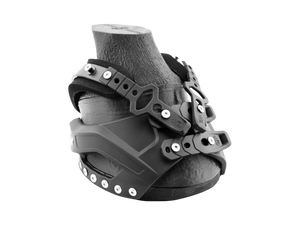
Glue-on horseshoes (glue-on shoes): Klebebeschläge are attached without nails and therefore cause no nail holes in the hoof wall. This protects the horn substance and can be a particularly gentle solution for horses with sensitive or thin hoof horn.

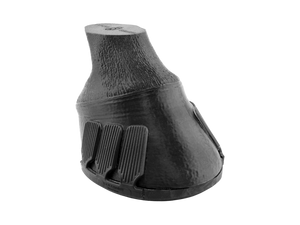
Hoof boots (hoof boots): Hoof boots are a flexible alternative to permanent shoeing. They are only put on as required – for example when riding on hard ground – and allow the hoof to use its full natural mobility the rest of the time. Especially during the transition phase from iron shoes to barefoot, hoof boots can effectively support and protect the horse.

Barefoot: an unshod hoof can in principle use its natural mobility most fully. However, whether a horse can go barefoot permanently depends on use, ground, hoof quality and individual circumstances.
In every case, the professional fitting of the chosen hoof protection to the individual horse and its use is decisive.
How to maintain your horse's hoof mechanism
A functional hoof mechanism does not arise by chance, but through consistent hoof management. The following
measures help to maintain and promote the natural hoof mechanics:
- Regular hoof trimming: every 6 to 8 weeks by a farrier or hoof care professional, adapted to your horse's individual anatomy.
- Sufficient movement: especially on different surfaces – because movement is the strongest activator of the hoof mechanism.
- Suitable hoof protection: choose a system that allows movement instead of blocking it, and ensure professional fitting.
- Varied ground: access to different surfaces in everyday life trains the hoof's adaptability.
- Targeted feeding: biotin, zinc, copper and vitamin E support horn quality and thus the elasticity of the hoof capsule.
The goal here is not maximum elasticity, but functional stability under the real conditions your horse encounters in everyday life.
Conclusion: the hoof mechanism – functional reality, not myth
The hoof mechanism is neither an ideological argument for or against certain hoof protection systems, nor an abstract theory. It is a biomechanical reality that takes place with every single step your horse takes – and which co-determines how healthy joints, tendons and ligaments remain in the long term.
The hoof is not a passive protective body – it is a highly functional organ that evolution has perfected over millions of years. Anyone who understands the hoof mechanism and supports it specifically lays one of the most important foundations for a horse with healthy movement.
Frequently asked questions about the hoof mechanism (FAQ)
What is meant by the hoof mechanism in horses?
The hoof mechanism is the natural elastic movement of the horse's hoof with every step. It ensures that the hoof capsule widens slightly on landing and returns to its original shape on lift-off.
Why is the hoof mechanism important?
It acts as a shock absorber, distributes forces evenly across the bearing surface, supports circulation in the lower leg of the horse and enables adaptation to changing ground conditions. Without it, joints, tendons and ligaments would be exposed to significantly higher loads.
What exactly happens during the hoof mechanism?
On landing, the heels widen, the sole flattens slightly and elastic structures in the rear of the hoof are compressed. On lift-off, all structures return and release the stored energy. This alternating movement takes place with every single step.
Is the hoof mechanism completely suppressed with horseshoes?
No. A shod hoof still deforms – however, mobility can be restricted to varying degrees depending on the material, the shoeing system and the type of attachment.
Which is better for the hoof mechanism – barefoot, hoof boot or shoeing?
That depends on use, ground and the individual circumstances of the horse. Barefoot enables the greatest natural mobility, hoof boots offer flexible protection as required, and modern plastic or glue-on shoes are significantly more elastic than classic iron shoes.
Does every horse have a hoof mechanism?
Yes. The capacity for elastic deformation is part of the natural basic function of every healthy horse's hoof.
Can a restricted hoof mechanism lead to problems?
Persistent, severe restriction can change loading patterns and encourage compensatory movements. Whether this actually leads to clinical problems depends on the intensity of use and individual anatomy.
How fast does a horse's hoof grow?
About 6 to 10 mm per month. It takes around 12 to 14 months for the entire toe wall to renew itself completely once. Sufficient movement and good circulation – promoted by a functioning hoof mechanism – favour healthy horn growth.
Which nutrients does my horse need for healthy hooves?
Particularly important are biotin, zinc, copper and vitamin E. These micronutrients support horn formation and contribute to elastic, resilient hoof horn.
How often should a farrier work on the hoof?
A farrier or hoof care professional should ideally come every 6 to 8 weeks for inspection and trimming. If the intervals become too long, this can impair the hoof mechanism and lead to imbalances.


