 Find a hoof expert
 Become a partner

Open or Closed Goodsmith Base Plate – Which Is the Right Choice?
Updated on 10/13/2026
In short
That depends on the hoof situation and area of use: the open base plate is suitable for healthy, insensitive hooves and is better ventilated. The closed one offers more stability and protection and is usually the preferred choice for sensitive soles and in rehab situations.
More articles in Glue-on horseshoe21
The choice between an open or closed Goodsmith base plate always depends on the individual hoof situation and the intended use. Both variants have clear advantages, which is why there is no generally “better” solution, only a more suitable one for your horse.
Open base plate
The open variant of the base plate is especially suitable for healthy, non-sensitive hooves:
- Better ventilation: The open design allows air to reach the sole more easily. This creates a drier environment and can support hoof health when there are no particular protection requirements.
- Lighter: Compared to the closed variant, the open base plate is slightly lighter. This can be an advantage especially for horses with sensitive musculature or in sport use – the less extra weight that needs to be carried, the better.
- Suitable for healthy hooves: If the sole is not sensitive and there is no rehab indication or particular need for protection, the open base plate is in many cases entirely sufficient.
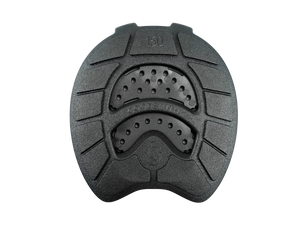
Closed base plate
The closed base plate is used mainly when more protection and stability are needed:
- More stability: The closed contact surface supports the sole over a larger area and stabilizes the hoof mechanism overall. This can be especially useful under high load, on uneven terrain, or on longer rides.
- Suitable for sensitive soles: For horses with a sensitive or thinner sole, the closed base plate can offer additional protection, since the contact area is distributed more evenly and localized pressure points are reduced.
- Better for rehab situations: In rehab cases – for example with sensitive soles, certain lameness patterns, or on veterinary recommendation – the closed base plate is usually the preferred choice, to support and protect the hoof as well as possible.
Conclusion: What does the decision depend on?
The decision between an open or closed base plate depends on:
- Hoof situation: Healthy, non-sensitive hooves usually get on well with an open base plate. For sensitive soles, rehab needs, or a higher need for protection, the closed variant has the advantage.
Ideally, you make this choice together with your farrier or hoof trimmer and – if your horse is under treatment – in consultation with your veterinarian. This ensures that the base plate is optimally suited to your horse's current hoof situation and intended use.
Thank you for your feedback.
This might also help
- At What Temperature Do I Weld the Goodsmith Tabs onto the Base Plate?Fitting & Adjusting
- Can I Re-weld a Single Tab?Fitting & Adjusting
- Can I Use Hoof Grease or Hoof Oil with Goodsmith Glue-on horseshoes?Fitting & Adjusting
- Can the Goodsmith Glue-on horseshoe Be Used in Sport, and Is There an LPO Approval?Selection & Suitability
