 Find a hoof expert
 Become a partner

At What Temperature Do I Weld the Goodsmith Tabs onto the Base Plate?
Updated on 10/13/2026
In short
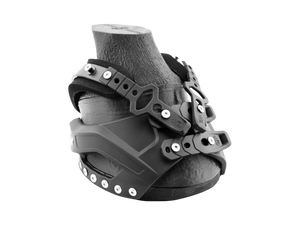
At the tab itself, the optimal temperature is around 180 to 220 °C, and you set the heat gun to at least 600 °C and maximum power and airflow. The tab should visibly fuse with the base plate without burning, so it is better to weld a little more than too little.
More articles in Glue-on horseshoe21
Optimal processing temperature for welding the tabs
The optimal processing temperature for welding the tabs is approx. 180 to 220 °C at the tab itself – depending on the tool used and your working technique.
It's important that:
- the tab fuses cleanly with the base plate,
- the material visibly bonds,
- the surface does not burn in the process (no dark or burnt spots, no greasy, burnt plastic).
If the material becomes too shiny, forms bubbles, or turns dark, it is too hot, or you are holding the tool on one spot for too long. If, on the other hand, the tabs only sit "on top" and can be easily lifted off again, the work was done too cold or too briefly.
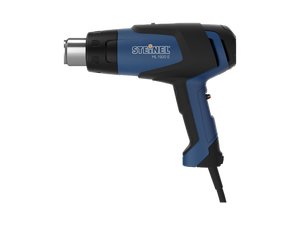
What kind of hot air gun do we recommend?
For welding the tabs, we recommend a powerful, high-quality hot air gun with a well-adjustable temperature and sufficient airflow.
It's important that the tool:
- delivers a constant temperature,
- has enough power and airflow to reliably weld the tabs,
- offers fine adjustment options for temperature and airflow.
Very basic or cheap tools often reach their limits here. They frequently don't have enough power or airflow. This can result in:
- the tabs not welding sufficiently,
- needing to heat significantly longer to achieve a result,
- the bond overall being less durable.
It's therefore worth investing in a high-quality hot air gun, especially if you work with Goodsmith systems regularly.
Recommended settings: temperature & airflow on the hot air gun
For the hot air gun itself, we recommend:
- Minimum temperature: 600 °C on the tool
- Setting: the highest or maximum power possible
- Airflow: also set to maximum airflow
This may seem high at first, but it makes sense:
- The air only hits the tab briefly and precisely,
- the surface of the tab heats up quickly and evenly,
- the material can fuse securely and deeply enough.
👉 Principle: It's better to weld a bit too strongly than too little. A weld that is too weak can cause tabs to come loose during use. A somewhat stronger weld, on the other hand, is usually not a problem, as long as the material does not visibly burn.
Practical tips for welding
- Keep the hot air gun moving, not held on one spot continuously.
- First heat the contact surface on the base plate, then the tab, until the material shows a slight sheen and becomes soft.
- Then press the tab on firmly (e.g. with a suitable tool or glove) and hold it briefly until the material has cooled.
- Finally, check whether the tab is firmly fused to the plate and can no longer be lifted off.
This ensures your Goodsmith tabs are welded stably, securely, and durably.
👉 Watch the video assembly instructions here for our Goodsmith glue-on horseshoe. In the chapter "Welding the tabs" we show you how to correctly connect the tabs to the base plate.
Thank you for your feedback.
This might also help
- Can I Re-weld a Single Tab?Fitting & Adjusting
- Can I Use Hoof Grease or Hoof Oil with Goodsmith Glue-on horseshoes?Fitting & Adjusting
- Can the Goodsmith Glue-on horseshoe Be Used in Sport, and Is There an LPO Approval?Selection & Suitability
- Does the Goodsmith Glue-on horseshoe Hold Up in Mud, Slush, and Wet Conditions?Selection & Suitability
