 Find a hoof expert
 Become a partner

Does my horse need hoof protection – and if so, which one?
Barefoot, shoes, glue-on shoes, hoof boots or something entirely different?
Barefoot is the most natural option for horses — after all, that's how horses are born. However, over the course of a horse's life, housing conditions, training and the horse's body itself change, and as a result, going barefoot may no longer be feasible without issues.
Does my horse need hoof protection?
Whether your horse needs hoof protection depends entirely on your horse and your requirements. As a general rule: if your horse moves better with hoof protection than without, then you should provide it. This can either be temporary (for example, only when riding) or permanent (e.g. because your horse is also sensitive when moving around in an open stable).
You should also consider hoof protection if it's foreseeable that the hooves will be particularly stressed in the future, e.g. during a trail ride or a move to an active stable with abrasive surfaces. Because: prevention is better than cure.
Typical situations in which hoof protection may be necessary:
- increased training workload (e.g. competition season, professional training, many long rides/trail rides, etc.)
- stable change (especially from box stall to open stable — our tip: take a close look at the surfaces in the new stable, hard ground often requires hoof protection)
- conditions affecting the hoof (e.g. laminitis, navicular syndrome, nail prick, and many more)
- generally, whenever hoof growth is slower than wear (e.g. due to hard surfaces in open stables, sharp-edged sand in the riding arena, poor mineralisation, etc.)
Which hoof protection is the right one?
There is now a very wide range of different hoof protection options. Here we present the most common versions at a glance:
Shoeing
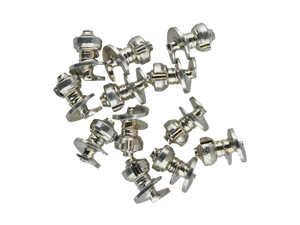
A shoe is a form of hoof protection that is attached to the horse's hoof with nails. There are two main variants:
- metal shoes (iron, aluminium)
- plastic shoes (usually with a metal core)
Shoes are probably the best-known form of hoof protection, as they have been around for a very long time. The main advantage lies in the price, as both the material and the labour time are low. However, a shoe also represents an intervention affecting the entire horse's body: the nails mechanically weaken the hoof wall and provide an entry point for fungi and bacteria. Metal is also very stiff (and often heavy), which means the hoof cannot flex naturally and the material is disadvantageous for the joints. With an open shoe, frog support is also missing, which is why shod hooves more often tend towards contracted hooves and thrush. These disadvantages can be partially compensated for by working with pads or similar.
Glue-on shoes
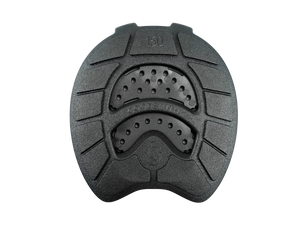
A glue-on is sometimes also called a "glue-on shoe"; here the hoof protection is attached to the hoof wall with adhesive. There are also various systems here:
- individual glue-ons, where the base plate is first fitted to the hoof and tab fingers are then welded to the plate using a heat gun; the tabs are then glued to the hoof wall using superglue
- prefabricated shells that are glued to the hoof wall using two-component adhesive
The glue-on from Goodsmith falls into the first category and thus offers the advantage that it can be individually adapted to each hoof. Glue-ons are of course available from various manufacturers, though many only offer base plates or only tabs. In addition, there are all sorts of designs for different requirements: harder, softer, thicker, thinner, various materials and shapes. The market has now become almost overwhelming, and for "glue-on beginners" it is often difficult to make the right choice. At Goodsmith we want more horses to be able to enjoy the benefits of a glue-on. That's why we have designed our product range so that we only offer one single type of glue-on — our "Perma XT glue-on shoe" — which can be modified in many ways as needed. Does your horse need more lateral stability because, for example, it turns a lot? No problem, then side caps can simply be added. We'll cover exactly what modification options are available in a separate article.
Advantages and disadvantages of glue-on shoes
The advantage of a glue-on is that it comes closer to the natural barefoot hoof than a conventional iron shoe: it provides frog support, the hoof mechanism is less restricted, and the sliding behaviour is also closer to barefoot. Glue-on shoes are therefore often referred to as "modern hoof protection", as it is only in more recent times that plastic production has been possible at such a high level, and they align with the modern understanding of hoof health.
The disadvantage of glue-ons is that the material is more expensive and the labour time can be higher. However, due to the reusability of the materials 1–2 times on average, the initial investment is reduced.
Hoof boots
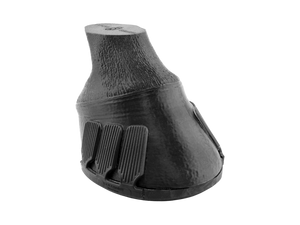
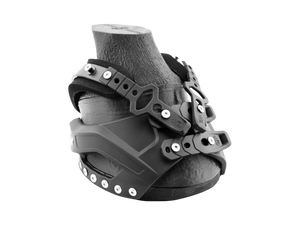
Hoof boots are put on and taken off as needed and closed around the horse's hoof and partly the pastern with tabs or straps. Here too there are different variants, e.g. made from a plastic shell or from fabric. The advantage of hoof boots therefore clearly lies in their flexibility: if your horse copes well without hoof protection in the stable or paddock, for example, but is a little sensitive when out riding, you can simply put on hoof boots for riding.
However, it's often not so easy to find the right boot. Similar to humans, there is a wide variety of different "foot shapes" and not every boot fits every shape.


Are there other hoof protection options?
There are also hybrid forms of the variants mentioned, for example horseshoes coated in plastic and fixed to the hoof with adhesive. Or entirely different variants, such as a cast bandage (a kind of plaster bandage around the hoof). Or plastic that is sprayed or cast directly onto the hoof. But these variants are intended more for special cases and must definitely be applied by specialists.
You can find a detailed comparison of all these variants, by the way, in this knowledge article of ours: What makes good hoof protection?
And as always: not every type of hoof protection suits every horse. And not every rider either. This article is therefore simply intended to show you options so that you can find the most suitable hoof protection variant for your horse. By the way: our certified Goodsmith partners come from many different training backgrounds and treatment approaches (farriers, hoof orthopaedists, hoof care specialists, hoof boot professionals, etc.) and will be happy to help you make a choice.
Author: Nathalie Kurz
