 Find a hoof expert
 Become a partner
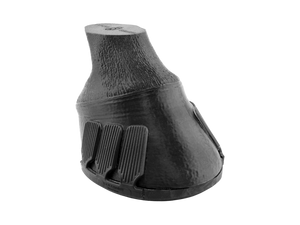
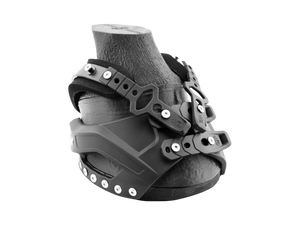
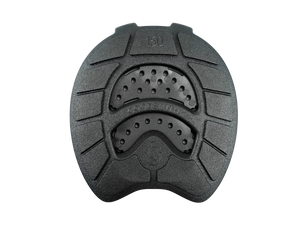
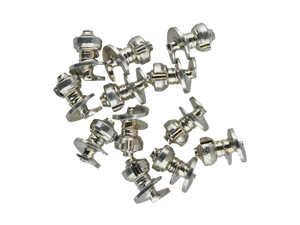

Glue-on horseshoe for arthrosis, suspensory ligament injury etc.
When horses have orthopedic problems – that is, misalignments, diseases, or injuries of the musculoskeletal system – veterinarians often recommend orthopedic shoeing. This refers to shoes that are either shaped differently, applied differently than normal shoes, or made of a different material or combined with other materials.
Since there is now a wide variety of glue-on alternatives to conventional shoeing available for healthy hooves, the question arises: are glue-ons also suitable for orthopedic problems?
To answer this, we first need to look at what goals orthopedic shoes aim to achieve. Then we can check whether the desired effect can also be achieved with modern plastic glue-ons.
Effects of orthopedic shoes
In the case of orthopedic diseases or injuries, a veterinarian is always required to make a diagnosis and develop a treatment plan. In many cases, this plan will also include orthopedic shoeing, meaning the veterinarian should define what goal is to be achieved with the hoof protection. The farrier or hoof care professional should then choose the most suitable individual implementation for this objective.
The following list shows which effects are commonly targeted with orthopedic glue-ons and whether these can also be achieved with glue-ons:
Cushioning
Especially with degenerative diseases such as arthrosis or ossification of the collateral cartilages, the shock-absorbing function of the hoof or joint is significantly reduced over time, and a cushioning insole in the shoe is intended to compensate for this function. But horses with thin soles or laminitis also often benefit from increased cushioning through pads and/or padding to reduce impact on the sensitive structures when landing.
Is this also possible with a glue-on?
Yes, definitely. Plastic plates without a metal core have the advantage that they provide more cushioning from the start than a rigid material such as steel or aluminum. In addition, glue-ons can also be equipped with soft inserts and pads that provide an extra dose of shock absorption.
Changing the breakover point
By changing the breakover point, you can influence when the hoof leaves the ground, i.e. how long it stays on the ground and how much the flexor apparatus of the respective limb is stretched. In the vast majority of cases, the goal is to move the breakover point backward so that the horse can break over more quickly, thereby relieving the flexor tendons and the navicular complex. This also reduces leverage on the hoof wall, which is desirable, for example, in cases of laminitis.
In rare cases (e.g. with foal club foot), on the other hand, the toe is artificially extended so that the hoof stays on the ground longer and the flexor tendons are stretched more.
Is this also possible with a glue-on?
Yes, absolutely. The base plate of a glue-on can be modified in shape (e.g. square toe), positioning on the hoof (e.g. set back), and with respect to the breakover point as desired. The plastic can be easily ground, which also makes strong rounding around the entire glue-on ("rock'n'roll shoe") possible.
Changing the medio-lateral balance
Medio-lateral balance refers to balancing the hoof between the inside and outside ("left-right").
In horses that, due to injuries, chronic diseases (e.g. bone spavin), or their conformation, place significantly more load on one side of the hoof than the other, this can lead to the more heavily loaded hoof wall being pushed under the hoof ("wall walker") and the load distribution within the hoof being shifted. The more heavily loaded side then appears "narrower" from below and the less loaded side appears "wider". In such cases, an orthopedic shoe is often recommended that features a widening on the underrun side to achieve a larger support surface on that side. This is intended to redistribute the load evenly – so the two halves of the hoof appear equal in size again.
Sometimes, by changing the medio-lateral balance, the aim is also to explicitly shift the load distribution to one side (i.e. a desired deviation from "normal" alignment), for example to temporarily relieve a tendon or joint in the case of an acute injury.
Is this also possible with a glue-on?
In principle, the plastic plate of a glue-on can also be widened on one side (e.g. by welding on additional plastic parts). However, it should be noted that the plastic – in contrast to a rigid horseshoe – is flexible, i.e. the plate deforms slightly when the hoof lands (which is normally also desired). Therefore, the plastic plate cannot be widened at will, because otherwise, due to its flexibility, a lever effect can occur on the more heavily loaded side of the hoof. However, if you are aware of this, you can counteract it with a little trick: the overhang of the widened plate can be filled up toward the hoof with synthetic horn to minimize deformation of the plastic plate.
Changing the dorso-palmar balance
Dorso-palmar balance refers to balancing the hoof between the toe and the heel area ("front-back").
With an orthopedic shoe, the hoof can be set more upright, for example to relieve the flexor tendons or the navicular complex. The branches in the heel area can also be extended or closed to enlarge the support surface or to prevent excessive sinking on soft ground (which is desirable, for example, in some cases of suspensory ligament damage). Wedges and/or bar shoes are usually used for this.
Is this also possible with a glue-on?
Yes, the dorso-palmar balance can also be influenced with a glue-on and the hoof set more upright. To do this, either the base plate itself can be beveled, or plastic wedges can be welded in. When extending the branches backward, similar considerations apply as with lateral widening: the plastic plate is flexible and could cause increased leverage on the heels. However, this can be addressed by stiffening the base plate in the heel area, for example with a rigid carbon insert.
Reducing hoof mechanism / stiffening the horn capsule
Normally, with hoof protection, you want to interfere with the natural hoof mechanism as little as possible, i.e. the horn capsule should be able to flex in all directions and blood circulation should not be restricted. In certain cases, however, the exact opposite is desired, and the hoof should be immobilized as much as possible for a limited period of time. This classically includes coffin bone (wing) fractures, keratoma surgeries, some laminitis cases, etc.
If the veterinarian considers immobilization of the hoof appropriate, a shoe that is as rigid as possible is classically chosen, which mechanically fixes the hoof capsule, e.g. with side clips, additional nails extending into the heel area, and/or closed shoes.
Is this also possible with a glue-on?
By default, a glue-on is designed to preserve the hoof mechanism as much as possible, so the restriction caused by the glue-on is only minimal. A normal glue-on is therefore not suitable for this. However, a glue-on shoe can be very well combined with rigid materials to achieve stiffening of the horn capsule. For example, the hoof can first be stabilized using a cast (a type of plaster bandage) before a glue-on is applied. Additional plastic side clips can also be attached to laterally limit the hoof mechanism. Nevertheless, plastic naturally does not achieve the same stiffness as metal. Therefore, in this case, it must be weighed how much the hoof mechanism should be eliminated in order to then select the appropriate material for the orthopedic hoof protection.
Conclusion
There is a wide variety of specialty shoes on the market; the list presented here represents only an excerpt of the most common variants. Other well-known orthopedic shoes include open-toe shoes, brushing shoes, hospital plate shoes, etc.
Whether these shoes need to be made of metal or can also be used in plastic or as glue-ons depends on the treatment goal individually determined for the respective horse. In any case, the objective must always be defined by the veterinarian. The hoof care professional should then decide which material can achieve the best effect without causing other disadvantages (e.g. nail holes).
In summary, it can be said that the vast majority of orthopedic shoes can also be achieved using plastic and applied to the hoof as a glued-on variant. Plastic can be used very flexibly and processed individually. A combination with other materials (e.g. wood for a Steward Clog or the attachment of an aluminum shoe) is also possible on a plastic base plate. However, this definitely requires an experienced hoof care professional who is familiar with the properties of the materials and their effects on the horse's statics and gait.
Author: Nathalie Kurz
>> Sources
- Conference proceedings of the 10th Hoof Conference of the DHG e.V., Konstanze Rasch
- https://www.waefler-hufbeschlag.ch/?page_id=62
-
{"@context":"http:\/\/schema.org\/","@id":"\/en\/blogs\/wissensdatenbank\/bekleb-bei-orthopadischen-problemen-klebebeschlag-bei-arthrose-fesseltragerschaden-etc#article","@type":"Article","mainEntityOfPage":{"@type":"WebPage","@id":"https:\/\/good-smith.com\/en\/blogs\/wissensdatenbank\/bekleb-bei-orthopadischen-problemen-klebebeschlag-bei-arthrose-fesseltragerschaden-etc"},"articleBody":"When horses have orthopedic problems – that is, misalignments, diseases, or injuries of the musculoskeletal system – veterinarians often recommend orthopedic shoeing. This refers to shoes that are either shaped differently, applied differently than normal shoes, or made of a different material or combined with other materials.\nSince there is now a wide variety of glue-on alternatives to conventional shoeing available for healthy hooves, the question arises: are glue-ons also suitable for orthopedic problems?\n\nTo answer this, we first need to look at what goals orthopedic shoes aim to achieve. Then we can check whether the desired effect can also be achieved with modern plastic glue-ons.\n\nEffects of orthopedic shoes\nIn the case of orthopedic diseases or injuries, a veterinarian is always required to make a diagnosis and develop a treatment plan. In many cases, this plan will also include orthopedic shoeing, meaning the veterinarian should define what goal is to be achieved with the hoof protection. The farrier or hoof care professional should then choose the most suitable individual implementation for this objective.\nThe following list shows which effects are commonly targeted with orthopedic glue-ons and whether these can also be achieved with glue-ons:\nCushioning\nEspecially with degenerative diseases such as arthrosis or ossification of the collateral cartilages, the shock-absorbing function of the hoof or joint is significantly reduced over time, and a cushioning insole in the shoe is intended to compensate for this function. But horses with thin soles or laminitis also often benefit from increased cushioning through pads and\/or padding to reduce impact on the sensitive structures when landing.\n\nIs this also possible with a glue-on?\nYes, definitely. Plastic plates without a metal core have the advantage that they provide more cushioning from the start than a rigid material such as steel or aluminum. In addition, glue-ons can also be equipped with soft inserts and pads that provide an extra dose of shock absorption.\nChanging the breakover point\nBy changing the breakover point, you can influence when the hoof leaves the ground, i.e. how long it stays on the ground and how much the flexor apparatus of the respective limb is stretched. In the vast majority of cases, the goal is to move the breakover point backward so that the horse can break over more quickly, thereby relieving the flexor tendons and the navicular complex. This also reduces leverage on the hoof wall, which is desirable, for example, in cases of laminitis.\nIn rare cases (e.g. with foal club foot), on the other hand, the toe is artificially extended so that the hoof stays on the ground longer and the flexor tendons are stretched more.\nIs this also possible with a glue-on?\nYes, absolutely. The base plate of a glue-on can be modified in shape (e.g. square toe), positioning on the hoof (e.g. set back), and with respect to the breakover point as desired. The plastic can be easily ground, which also makes strong rounding around the entire glue-on (\"rock'n'roll shoe\") possible.\nChanging the medio-lateral balance\nMedio-lateral balance refers to balancing the hoof between the inside and outside (\"left-right\").\nIn horses that, due to injuries, chronic diseases (e.g. bone spavin), or their conformation, place significantly more load on one side of the hoof than the other, this can lead to the more heavily loaded hoof wall being pushed under the hoof (\"wall walker\") and the load distribution within the hoof being shifted. The more heavily loaded side then appears \"narrower\" from below and the less loaded side appears \"wider\". In such cases, an orthopedic shoe is often recommended that features a widening on the underrun side to achieve a larger support surface on that side. This is intended to redistribute the load evenly – so the two halves of the hoof appear equal in size again.\nSometimes, by changing the medio-lateral balance, the aim is also to explicitly shift the load distribution to one side (i.e. a desired deviation from \"normal\" alignment), for example to temporarily relieve a tendon or joint in the case of an acute injury.\nIs this also possible with a glue-on?\nIn principle, the plastic plate of a glue-on can also be widened on one side (e.g. by welding on additional plastic parts). However, it should be noted that the plastic – in contrast to a rigid horseshoe – is flexible, i.e. the plate deforms slightly when the hoof lands (which is normally also desired). Therefore, the plastic plate cannot be widened at will, because otherwise, due to its flexibility, a lever effect can occur on the more heavily loaded side of the hoof. However, if you are aware of this, you can counteract it with a little trick: the overhang of the widened plate can be filled up toward the hoof with synthetic horn to minimize deformation of the plastic plate.\nChanging the dorso-palmar balance\nDorso-palmar balance refers to balancing the hoof between the toe and the heel area (\"front-back\").\nWith an orthopedic shoe, the hoof can be set more upright, for example to relieve the flexor tendons or the navicular complex. The branches in the heel area can also be extended or closed to enlarge the support surface or to prevent excessive sinking on soft ground (which is desirable, for example, in some cases of suspensory ligament damage). Wedges and\/or bar shoes are usually used for this.\n\nIs this also possible with a glue-on?\nYes, the dorso-palmar balance can also be influenced with a glue-on and the hoof set more upright. To do this, either the base plate itself can be beveled, or plastic wedges can be welded in. When extending the branches backward, similar considerations apply as with lateral widening: the plastic plate is flexible and could cause increased leverage on the heels. However, this can be addressed by stiffening the base plate in the heel area, for example with a rigid carbon insert.\n\nReducing hoof mechanism \/ stiffening the horn capsule\nNormally, with hoof protection, you want to interfere with the natural hoof mechanism as little as possible, i.e. the horn capsule should be able to flex in all directions and blood circulation should not be restricted. In certain cases, however, the exact opposite is desired, and the hoof should be immobilized as much as possible for a limited period of time. This classically includes coffin bone (wing) fractures, keratoma surgeries, some laminitis cases, etc.\nIf the veterinarian considers immobilization of the hoof appropriate, a shoe that is as rigid as possible is classically chosen, which mechanically fixes the hoof capsule, e.g. with side clips, additional nails extending into the heel area, and\/or closed shoes.\n\nIs this also possible with a glue-on?\nBy default, a glue-on is designed to preserve the hoof mechanism as much as possible, so the restriction caused by the glue-on is only minimal. A normal glue-on is therefore not suitable for this. However, a glue-on shoe can be very well combined with rigid materials to achieve stiffening of the horn capsule. For example, the hoof can first be stabilized using a cast (a type of plaster bandage) before a glue-on is applied. Additional plastic side clips can also be attached to laterally limit the hoof mechanism. Nevertheless, plastic naturally does not achieve the same stiffness as metal. Therefore, in this case, it must be weighed how much the hoof mechanism should be eliminated in order to then select the appropriate material for the orthopedic hoof protection.\n\nConclusion\nThere is a wide variety of specialty shoes on the market; the list presented here represents only an excerpt of the most common variants. Other well-known orthopedic shoes include open-toe shoes, brushing shoes, hospital plate shoes, etc.\nWhether these shoes need to be made of metal or can also be used in plastic or as glue-ons depends on the treatment goal individually determined for the respective horse. In any case, the objective must always be defined by the veterinarian. The hoof care professional should then decide which material can achieve the best effect without causing other disadvantages (e.g. nail holes).\n\nIn summary, it can be said that the vast majority of orthopedic shoes can also be achieved using plastic and applied to the hoof as a glued-on variant. Plastic can be used very flexibly and processed individually. A combination with other materials (e.g. wood for a Steward Clog or the attachment of an aluminum shoe) is also possible on a plastic base plate. However, this definitely requires an experienced hoof care professional who is familiar with the properties of the materials and their effects on the horse's statics and gait.\n \nAuthor: Nathalie Kurz\n\n\n\u0026gt;\u0026gt; Sources \n \n\nConference proceedings of the 10th Hoof Conference of the DHG e.V., Konstanze Rasch\nhttps:\/\/www.waefler-hufbeschlag.ch\/?page_id=62\n\u003cli style=\"font-weight:","headline":"Glue-on horseshoe for arthrosis, suspensory ligament injury etc.","description":"","image":"https:\/\/good-smith.com\/cdn\/shop\/articles\/orthopaedischer_Bekleb_f032079a-bccb-456d-a5d1-bacd6f05dce8.png?v=1787303847\u0026width=1920","datePublished":"2023-08-24T15:36:51+02:00","dateModified":"2023-08-30T14:05:41+02:00","author":{"@type":"Person","name":"Eva Schroeder"},"publisher":{"@type":"Organization","name":"Goodsmith "}}
- Choosing a selection results in a full page refresh.
- Opens in a new window.
