 Find a hoof expert
 Become a partner

Identifying and treating contracted hooves

Contracted hooves are a fairly widespread phenomenon in the horse world, but they often go unrecognised or are regarded as irreversible. That, however, is not true! Usually all it takes is a change in trimming and sometimes the support of an adapted permanent hoof protection to treat the contraction in the hoof.

What is a contracted hoof?
A contracted hoof means that there is an incorrect balance of forces somewhere in the hoof, so that part of the hoof is mechanically "squeezed in" by the hoof capsule. Depending on which part of the hoof is affected by the contraction, the following types are distinguished:
- Heel contraction (Trachtenzwang)
- Bulb contraction (Ballenzwang)
- Sole contraction (Sohlenzwang)
- Coronet contraction (Kronzwang)
As a result, the dermis (the structure within the hoof responsible for horn production) is compressed in the affected area and less well supplied with blood. As a consequence, less horn is produced and the affected part of the hoof essentially withers. Depending on the type of contracted hoof, this can lead to secondary problems such as thrush, abscesses, misalignment or an altered gait due to pain.
To better understand the individual types of contraction, a bit of anatomy knowledge is required - we therefore recommend our article on hoof anatomy.

Heel contraction (Trachtenzwang)
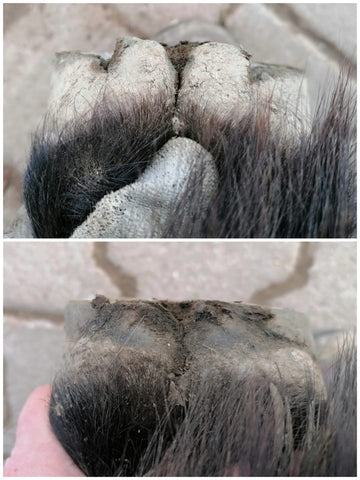
Heel contraction is probably one of the most common types of contraction. The hoof is too narrow in the heel area, which is often caused by one (or more) of the following points:
- bars that are too long
- an overall hoof that is too long
- heels that are too high
- an atrophied frog (e.g. due to thrush)
Heel contraction can also occur as early as during the rearing of young horses if husbandry conditions are not suitable: if the frog and sole do not experience sufficient counter-pressure from the ground (e.g. on very soft or very hard surfaces), these structures cannot develop adequately and cannot fulfil their "load-bearing" role in the hoof. The hoof wall and bars, which by contrast become excessively strong, then constrict the hoof in the heel area. This creates a vicious circle: due to the narrow heel area the frog dermis is pinched and produces less frog horn. As a result the frog atrophies further and can offer even less counter-pressure to the heels. Due to the poorer blood supply, the frog is also more susceptible to thrush - more on this in our article.
The solution to remedy heel contraction therefore lies on the one hand in removing the cause (e.g. by appropriate trimming of the hoof) and on the other hand in supporting the frog area. If thrush is present, it must be treated meticulously. If the frog has already atrophied so much that it no longer has ground contact, care should be taken to (carefully) restore counter-pressure from the ground so that it can grow better. Because only a strong frog is able to push the heel area apart under load (i.e. with every step) and thus eliminate heel contraction.
Ground contact can be achieved either through a suitable surface in the stable (e.g. sand) or through a shoe or glue-on (Bekleb) with a pad.
To prevent heel contraction from occurring in the first place, regular hoof trimming and good support for the frog should always be ensured. That is also why it is so important that any permanent hoof protection (whether iron or plastic) offers good support in the frog area and the frog does not "hang in the air".
Bulb contraction (Ballenzwang)
Bulb contraction is very similar to heel contraction, which is why some hoof care practitioners do not differentiate between them. Because in bulb contraction the rear part of the hoof is affected by the contraction as well. The subtle difference is that in bulb contraction only the bulbs are pinched, whereas the ground-side part of the heels still appears appropriately wide. The heels therefore essentially collapse over the frog. You can best see the difference by looking at the hoof from behind: with heel contraction the heels are straight (i.e. approximately parallel to each other), with bulb contraction however they are closer together at the coronet than at the ground (they form an inverted "V").
The causes of bulb contraction are also often different from those of heel contraction, namely:
- sidewalls that are too long
- heels that are too long (not too high!), often underrun
- shoeing without frog support, so that the frog sinks downward
To remedy bulb contraction it is necessary (just as with heel contraction) on the one hand to remove the cause and on the other hand to provide good frog support so that the frog can push the bulb area apart.
Sole contraction (Sohlenzwang)
In contrast to heel and bulb contraction, sole contraction is less well known among horse owners. It often requires the trained eye of a specialist to recognise this type of contracted hoof. With sole contraction, the pinched part is not so clearly visible because the sole presses inward. However, this does not happen evenly throughout the hoof: towards the toe, sole horn "accumulates" upward (so there is too much sole material here), whereas towards the point of frog there tends to be too little sole horn, because the dermis is particularly compressed there.
Due to all the material at the toe tip, the position of the coffin bone can even be altered: the tip of the coffin bone is pushed upward and the palmar angle of the coffin bone becomes shallower. As a result, the wall horn also often no longer grows straight down at the toe, but slightly convex (called "claw-like growth" or "bull-nose").
The cause of sole contraction is often a toe that is too high or heels that are too short (which makes the palmar angle of the coffin bone too shallow or even negative). In any case, the excess sole horn in the toe area should be removed and the toe height reduced as much as possible so that the sole can relax again.
Coronet contraction (Kronzwang)
The natural shape of the horse's hoof (viewed from the front) corresponds to a cone: the hoof wall does not stand straight at a right angle to the ground but is angled. The hoof is narrower at the coronet than near the ground, with the wall running straight (i.e. without "dents" or "bulges"). In coronet contraction, however, growth reverses: the hoof grows narrower downward, i.e. the hoof is wider at the coronet than the wall below.
This type of contracted hoof is almost always caused by overly tight shoeing or hoof walls that are too long. Because if the hoof wall near the ground is fixed too rigidly by a shoe, it cannot grow conically downward and presses up against the coronet, which redirects the growth direction inward. The same applies to hooves that are too long, when the load is no longer distributed evenly over the entire hoof but only the walls bear the entire load; in this case too the walls press upward and push the newly growing horn inward.
Author: Nathalie Kurz
Images: Nathalie Kurz, Barbara Stöffl
>> Sources
https://www.barhufteam.ch/zwanghufe_beim_pferd.htmlhttps://www.equine-institut.com/de/hufkrankheiten/zwanghuf.htmlhttps://www.dhgev.de/en/hoof-articles/the-contracted-hoofhttps://proequinegrooms.com/tips/legs-and-hooves/contracted-heels-horses/https://www.theequinedocumentalist.com/post/evidence-based-podiatryhttp://www.lauenscheid.de/oldpage/html/zwang.php
