 Find a hoof expert
 Become a partner

Inflammation of the hoof dermis - "Pododermatitis"
The corium (or laminar dermis) is the "living" (blood-supplied) layer directly beneath the horn capsule. It is responsible for horn production and effectively connects the inner structures of the hoof with the horn capsule.
When the corium becomes inflamed, it swells just as other tissue types do in response to an inflammatory reaction. However, because the hoof capsule is very rigid, the swelling presses on sensitive tissue and causes significant pain. Depending on the cause and location of the coronitis, different conditions are distinguished.
Different types of coronitis
There are various types of corium within the hoof, and all of them can become inflamed: perioplic, bulbar, solar, frog and wall corium. The inflammation can be either locally confined or diffuse (widespread).
In addition, inflammation of the corium can have various causes: it can be caused by bacteria (= septic, purulent) or it can develop without the involvement of a pathogen (= aseptic, non-purulent).
Furthermore, coronitis can be either acute or chronic.
Depending on the combination of these factors, the following variants can be distinguished:
- septic coronitis: this is referred to as an abscess or hoof ulcer
- aseptic coronitis: within this category, the following forms can be distinguished:
- acute or chronic inflammation of the perioplic corium (e.g. caused by irritating "care" substances)
- acute localized coronitis due to trauma (this also includes "bruises/corns")
- acute diffuse inflammation of the solar corium (e.g. due to overload or overly invasive hoof trimming)
- by definition, laminitis is also considered a non-purulent form of coronitis – but be aware: there are various causes of laminitis, and the most common of these (a hormonal metabolism issue) is not accompanied by inflammation of the corium
The diagnosis of "coronitis" is therefore very imprecise, since depending on the specific type, the course of the disease and the treatment can be completely different. A hoof abscess must be treated in an entirely different way than an inflammation of the perioplic corium or a bruise.
When people commonly refer to "coronitis" without specifying it more precisely, they usually mean an aseptic (i.e. non-purulent) form, either of the solar corium or a locally confined inflammation resulting from trauma. We will therefore take a closer look at this form.
Aseptic localized coronitis
A locally confined, acute inflammation of the corium without pus is usually caused by trauma, i.e. an external force. Triggers include, for example:
- stones (wedged into the lateral sulci of the frog or under a shoe, or a heavy step onto a stone), which is why this form is also called a "bruise" or "corn"
- incorrectly fitted/applied horseshoes (e.g. too short or too wide, pressing side clips, etc.)
- pressure from horseshoe nails
- the hoof striking the stall wall or jumping poles
Later, as the horn grows out, the affected areas often appear on light-colored hooves as yellowish or orange-reddish stained horn that is frequently more compressed as well ("emergency horn"). On dark hooves, such discoloration is not visible, but the affected areas are of course still present.
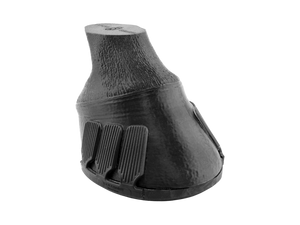
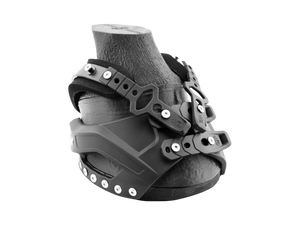
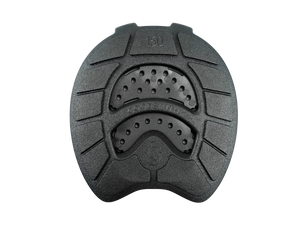
Aseptic coronitis normally subsides on its own once the cause is eliminated. The hoof can, however, be supported by relieving pressure on the inflamed area and providing a soft surface (e.g. a stall with soft bedding, or temporary hoof protection). In more severe cases, painkillers and anti-inflammatory medications are also useful.
Text and images: Nathalie Kurz
>> Sources
- https://campus.fei.org/local/globalglossary/view.php?mode=letter&hook=pododermatitis
- https://kernkompetenz-pferd.de/hufgeschwuer-beim-pferd/
- "Der Huf: Lehrbuch des Hufbeschlages", Lutz-Ferdinand Litzke and Burkhard Rau, 2012, 6th edition
- https://www.tiermedizinportal.de/tierkrankheiten/pferdekrankheiten/huflederhaut-entzundung-pododermatitis-beim-pferd
- http://www.go-barhuf.de/index.php?p=156000
