 Find a hoof expert
 Become a partner

Wedges in the glue-on horseshoe
Modifying load distribution within the hoof
Wedges are inserts placed between the hoof and the shoe/glue-on that are higher in the heel area and taper evenly towards the toe. Wedges come in various heights or angles. The specification indicates by how many degrees they increase the coffin bone–ground angle.
But what are wedges actually needed for? Wedges are used to make the hoof "steeper", that is, to influence the coffin bone–ground angle. This changes the load distribution within the hoof; for example, the flexor tendons (and thereby the navicular complex) are relieved. This can be useful in the case of injuries or acute inflammation in order to relieve the affected tissue. However, one must be aware that relieving one structure means that one (or more) other region(s) will be loaded more or even overloaded. Therefore, in the vast majority of cases, wedges should only be used short-term and should be reduced again as soon as possible so that no damage occurs to other structures.
It is also often assumed that wedges would bring an improvement in cases of collapsed heels or a negative coffin bone angle, because they can compensate for the missing heel height. From a static perspective this is correct (the coffin bone–ground angle is improved), but wedges also shift the centre of pressure load within the hoof towards the heels. The heels are therefore loaded more by the wedges – if these are already weak or even collapsed, then wedges (used long-term) lead to no improvement or even a worsening of the situation. This problem can be mitigated by the use of hoof pads, so that pressure distribution is more evenly spread across the entire hoof (and in particular onto the frog).
Wedge pads should therefore mostly be used as a temporary measure in the course of an orthopaedic shoeing or glue-on application. It is also important to use wedges together with hoof pads so that the altered load distribution burdens the heels as little as possible, especially when these are already weak.
Wedges are available in different materials, e.g. leather or plastic. Leather inserts have better shock absorption but also tend to compress more. Plastic, on the other hand, remains relatively dimensionally stable over the shoeing period.
The Goodsmith wedge insert
The Goodsmith wedges are designed at a low height (2.5°) and can be combined (stacked) if needed. This makes it possible, for example in the case of a tendon injury, to set the hoof significantly steeper in the short term and to gradually reduce it as recovery progresses.
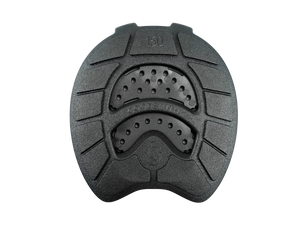
The Goodsmith wedges are also particularly easy to handle, as they are perfectly matched to the Goodsmith base plate: thanks to the plug-in system, they can simply be inserted into the frog recess hole in the base plate – so nothing can slip out of place. In addition, the wedges can be fixed with a few dabs of superglue, so that the wedge–base plate combination can be marked on the hoof together and cut precisely to fit the individual hoof.
Since the Goodsmith wedges are made of the same TPU material as the base plate, they can also be welded to it. The tabs are then simply welded onto the combined wedge/base plate assembly.
Author: Nathalie Kurz
Images: Goodsmith archive
Sources
