 Find a hoof expert
 Become a partner
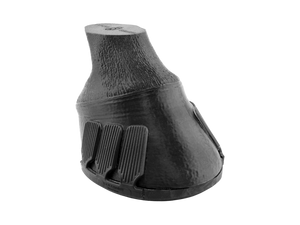
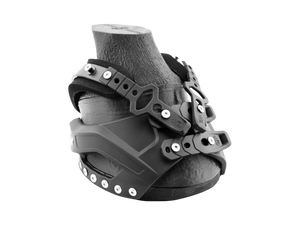
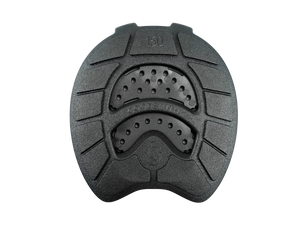

Clips (caps) for glue-on shoes
A glue-on shoe generally does not need clips. Clips – also called caps or toe/side clips – originate from nailed shoeing, where their job is to relieve the nails. With a glue-on shoe there are neither nails nor nail holes, and the glue tabs distribute the forces over a large area of the hoof capsule anyway. There are, however, horses that place such concentrated stress on the shoe that an additional clip makes sense. For these cases there are plastic clips that can be positioned freely on the glue-on shoe. Whether a horse needs them is shown by the hoof itself and is decided together with the farrier.

What a clip is and what it does
A clip is the triangular tab on the shoe that projects upwards against the hoof wall and is formed into the hoof wall. It takes on part of the forces acting between hoof and shoe during landing, breakover and rotational movement. On a horseshoe, this relieves the nails and nail holes: with clips, either fewer nails can be set, or the nails that are set carry less load. Common arrangements are a single toe clip in the centre or two side clips.
On a glue-on shoe, only one of these two tasks remains. There are no nails that need relieving. But a glue-on shoe can also use additional resistance against shear forces, and that is exactly what the clip is used for here.
Why a glue-on shoe usually does without clips
On a glue-on shoe, the glue tabs handle the force transmission. They enclose the hoof capsule like a crown and channel the forces into the hoof wall via a large glued surface rather than a few individual points.
Then there is the material. Tabs and base plates are made of high-strength TPU – both formable and tear-resistant. A hoof capsule surrounded by flexible plastic can move more under load than one bordered laterally by rigid metal. The hoof wall also grows from the coronet down towards the bearing edge, following the wall angle: the hoof is wider at the bottom than at the top. Yielding material gives this growth more room.
The tab neck deliberately incorporates a predetermined breaking point. If the shoe catches on something, or the horse steps on its own glue-on shoe, the tab tears there in a controlled way rather than damaging the hoof wall. This is an intentional safety mechanism – and at the same time the reason why tabs also tear in rare cases when you would rather they didn't.


When clips make sense on a glue-on shoe
From our work with users and farriers, we know typical situations in which particularly high forces act on individual tabs:
- Jumping and tight turns – here the load falls mainly on the front tabs of the hoof.
- Horses that turn a lot on the leg while standing – here the shear forces hit the rearmost tabs of a tab collar.
- Hooves with pronounced rotational movement during breakover, where the shoe is heavily stressed laterally.
These are observations from practical use, not measured values. The most reliable indicator comes from the horse itself: if a tab repeatedly tears in the same place, or the glue-on shoe consistently drifts in the same direction, that is the moment to consider a clip at exactly that spot. Clips set preventively all the way around, on the other hand, achieve little and stiffen the shoe unnecessarily.
Plastic clips: material, sizes, processing
The clips for the glue-on shoe are made of the same TPU as the base plates and tab collars. They are warmed with the heat gun, formed directly on the hoof and welded to the other components of the shoe – the same working method farriers already know from the rest of the system. No additional tool is required.
Size |
{"@context":"http:\/\/schema.org\/","@id":"\/en\/blogs\/wissensdatenbank\/aufzuge-kappen-fur-klebebeschlage#article","@type":"Article","mainEntityOfPage":{"@type":"WebPage","@id":"https:\/\/good-smith.com\/en\/blogs\/wissensdatenbank\/aufzuge-kappen-fur-klebebeschlage"},"articleBody":"\n \n \n \n \n \n \n A glue-on shoe generally does not need clips. Clips – also called caps or toe\/side clips – originate from nailed shoeing, where their job is to relieve the nails. With a glue-on shoe there are neither nails nor nail holes, and the glue tabs distribute the forces over a large area of the hoof capsule anyway. There are, however, horses that place such concentrated stress on the shoe that an additional clip makes sense. For these cases there are plastic clips that can be positioned freely on the glue-on shoe. Whether a horse needs them is shown by the hoof itself and is decided together with the farrier.\n \n\n \n \n \n \n \n \n\n What a clip is and what it does\n \n \n A clip is the triangular tab on the shoe that projects upwards against the hoof wall and is formed into the hoof wall. It takes on part of the forces acting between hoof and shoe during landing, breakover and rotational movement. On a horseshoe, this relieves the nails and nail holes: with clips, either fewer nails can be set, or the nails that are set carry less load. Common arrangements are a single toe clip in the centre or two side clips.\nOn a glue-on shoe, only one of these two tasks remains. There are no nails that need relieving. But a glue-on shoe can also use additional resistance against shear forces, and that is exactly what the clip is used for here.\n \n\n Why a glue-on shoe usually does without clips\n \n \n On a glue-on shoe, the glue tabs handle the force transmission. They enclose the hoof capsule like a crown and channel the forces into the hoof wall via a large glued surface rather than a few individual points.\nThen there is the material. Tabs and base plates are made of high-strength TPU – both formable and tear-resistant. A hoof capsule surrounded by flexible plastic can move more under load than one bordered laterally by rigid metal. The hoof wall also grows from the coronet down towards the bearing edge, following the wall angle: the hoof is wider at the bottom than at the top. Yielding material gives this growth more room.\nThe tab neck deliberately incorporates a predetermined breaking point. If the shoe catches on something, or the horse steps on its own glue-on shoe, the tab tears there in a controlled way rather than damaging the hoof wall. This is an intentional safety mechanism – and at the same time the reason why tabs also tear in rare cases when you would rather they didn't.\n \n\n \n \n\n \n \n What is a glue-on shoe?\n \n \n Learn more here\n \n \n \n\n\n \n \n What is the hoof mechanism in the horse?\n \n \n Learn more here\n \n \n \n \n \n \n When clips make sense on a glue-on shoe\n \n \n From our work with users and farriers, we know typical situations in which particularly high forces act on individual tabs:\n\nJumping and tight turns – here the load falls mainly on the front tabs of the hoof.\nHorses that turn a lot on the leg while standing – here the shear forces hit the rearmost tabs of a tab collar.\nHooves with pronounced rotational movement during breakover, where the shoe is heavily stressed laterally.\n\nThese are observations from practical use, not measured values. The most reliable indicator comes from the horse itself: if a tab repeatedly tears in the same place, or the glue-on shoe consistently drifts in the same direction, that is the moment to consider a clip at exactly that spot. Clips set preventively all the way around, on the other hand, achieve little and stiffen the shoe unnecessarily.\n \n\n Plastic clips: material, sizes, processing\n \n \n The clips for the glue-on shoe are made of the same TPU as the base plates and tab collars. They are warmed with the heat gun, formed directly on the hoof and welded to the other components of the shoe – the same working method farriers already know from the rest of the system. No additional tool is required.\n\n\nSize\n\u003ctd width=\"28.881469115191987%\" valign=\"top","headline":"Clips (caps) for glue-on shoes","description":"","image":"https:\/\/good-smith.com\/cdn\/shop\/articles\/Aufzuege_Kappen_Klebebeschlag_53d13fa6-0eb2-4a3e-95de-a2a6c80be59f.png?v=1789977959\u0026width=1920","datePublished":"2024-07-10T12:41:21+02:00","dateModified":"2024-07-10T00:00:00+02:00","author":{"@type":"Person","name":"Eva Schroeder"},"publisher":{"@type":"Organization","name":"Goodsmith "}}
|
