 Find a hoof expert
 Become a partner

The Tabs Are Tearing at the Predetermined Breaking Points – What Can I Do?
Updated on 10/13/2026
In short
The predetermined breaking points are designed to tear under massive strain so that your horse is protected. If they tear anyway, common causes are a worn-down shoe, a base plate that is too large or too small, or an unfavourable position of the tabs. With strong thrust or twisting hooves, the optional clips can relieve the tabs.
More articles in Glue-on horseshoe21
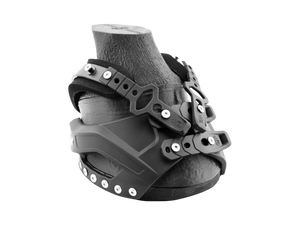
Our glue-on horseshoes are designed to keep the risk of injury to your horse as low as possible. That's why the glue tabs have predetermined breaking points, which tear open in a controlled way under extreme load. This prevents excessive forces from acting on tendons and joints in an emergency.
At the same time, the tabs are designed to easily withstand normal everyday loads. If tabs still tear at the breaking points, it's worth taking a closer look at fitting and use.
Was the shoe possibly stepped off?
A common cause of tearing tabs is a shoe that has been stepped off.
Check the following:
- Overhang of the base plate at the heels
The overhang should be as small as possible. If the plate sticks out too far at the back, for example the hind hoof can more easily catch on the plate of the front hoof and step the shoe off. - Bevel in the heel area
You can grind a slight bevel into the heel area so the hind hoof has less to catch on. - Grinding the break-over point
A slightly ground break-over point on the base plate helps the hoof "break over" more quickly and reduces the risk of it being stepped off.
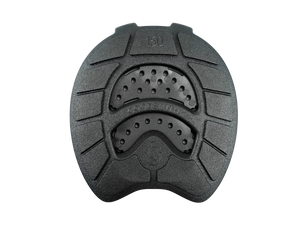
Was the base plate fitted too large or too small?
The correct fit of the base plate is crucial:
Base plate too large
- The hoof has too much play within the plate.
- This results in stronger dynamic movements, which puts significantly higher forces on the tabs and breaking points.
- Result: the breaking points can tear under this additional load.
Base plate too small
- The tabs are under constant tension from the start.
- Although the tabs are elastic to compensate for certain movements, this elasticity is not unlimited.
- Continuous overloading can cause the tabs to tear at the breaking points.
Therefore, make sure the base plate is fitted precisely: neither too large nor too small.
Does your horse have particularly strong drive or strongly rotating hooves?
Some horses have:
- a very strong forward drive, or
- strongly rotating hooves (e.g. when turning or in confined spaces).
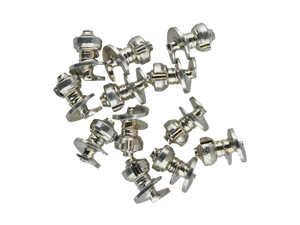
In such cases, we recommend using our optional extension tabs.
These can:
- better absorb drive forces and rotational movements,
- additionally relieve the tabs,
- without increasing the risk of injury.
Were the glue tabs positioned correctly?
The positioning of the tabs also plays an important role in durability:
- The rear tab finger should be positioned just past the widest point of the hoof.
- For horses with extremely high load, it can make sense to attach additional tab fingers in the toe area to distribute the forces better.
Unfavorable positioning can cause the tabs to be excessively loaded at certain points and then tear at the breaking points.
If you're unsure: contact us
If you're unsure why your tabs are tearing, or if the problem keeps occurring despite adjustments:
- Feel free to contact our customer service.
- Please send us meaningful photos if possible (e.g. hoof from all sides, underside with base plate, wear, torn tabs).
We're happy to take a look at your case and give you individual tips on how to further improve durability in your specific situation.
Thank you for your feedback.
This might also help
- At What Temperature Do I Weld the Goodsmith Tabs onto the Base Plate?Fitting & Adjusting
- Can I Re-weld a Single Tab?Fitting & Adjusting
- Can I Use Hoof Grease or Hoof Oil with Goodsmith Glue-on horseshoes?Fitting & Adjusting
- Can the Goodsmith Glue-on horseshoe Be Used in Sport, and Is There an LPO Approval?Selection & Suitability
