 Find a hoof expert
 Become a partner


Rehab Base Plate in Use
The adaptable solution for a wide range of hoof problems
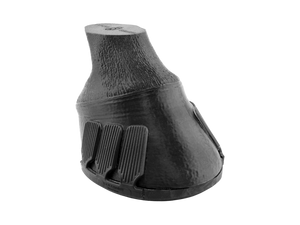
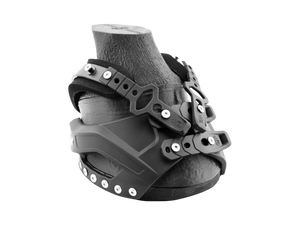
The standard glue-on shoe from Goodsmith ("Perma XT glue-on shoe") is already designed for a wide range of hoof challenges and can be modified in many versatile ways. However, there are recurring similar hoof problems where modifying the standard base plate is feasible but requires considerable effort. Since we at Goodsmith always look for the simplest possible solutions, we sat down with numerous hoof professionals (barefoot trimmers, hoof technicians, and farriers) and gathered their feedback on various prototypes for an "all-round problem hoof base plate". The result is our unique Rehab base plate.
What sets the Rehab base plate apart from the standard base plate?
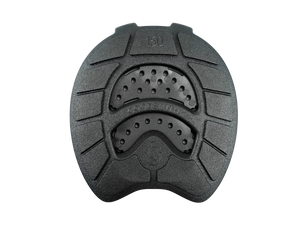
The Rehab plate is closed in the frog area (rather than slotted) and is overall thicker than the standard base plate. This gives the Rehab base plate greater rigidity. Less flexibility means less movement in the hoof — because particularly in cases of inflammation within the hoof, the hoof mechanism often needs to be reduced (on veterinary instruction) to avoid further irritating damaged tissue. The same result could be achieved with a metal core, but this would significantly increase the weight of the base plate; that's why the Rehab plate is still made exclusively from plastic (TPU).
The Rehab base plate also differs from the standard glue-on shoe through its recessed grid: it is lowered so that even on hooves with a shallow sole arch (or even a bulging sole, e.g. in cases of coffin bone rotation), a sufficiently thick hoof pad (kneadable or pourable pad) can be applied. Because only when such a pad has a certain thickness can it actually fulfil its cushioning or supporting function. Since with some hoof conditions you also want to work with pads of different hardness, the pad area is divided by a ridge. This ridge is also recessed so it can't cause pressure anywhere, but it still offers the option of placing two different pads in the base plate. Of course, a single continuous pad made of one uniform material can also be applied, and the ridge can simply be ground out if needed.
Another difference between the standard base plate and the Rehab plate is the underside: it is slightly curved. In the middle there is a flat standing surface, but the profile is significantly bevelled towards the edge. This allows the horse not only to break over more easily to the front, but also to turn sideways more easily without applying too much leverage to the hoof wall. This makes movement easier for horses, particularly with painful conditions such as laminitis or navicular syndrome.
Of course, this pronounced curvature can also be further modified by the hoof care professional, so that the break-over behaviour can be truly tailored to the individual horse.
Which hoof problems is the Rehab glue-on suitable for?
The original idea behind the Rehab base plate was primarily intended for laminitis patients, for whom elaborate specialist solutions have often been devised. One approach that has proven itself here is the so-called "Steward Clog", a heavily rounded wooden plate that was attached to the hoof. However, this was often screwed to the hoof, since laminitic horses cannot tolerate nailing due to the vibrations. But even with screws, the already stressed hoof wall is further damaged. A glued solution therefore offers clear advantages here.
During product development and in collaboration with various hoof professionals, it quickly became apparent that the recessed grid and the easier break-over behaviour bring noticeable relief not only for laminitic horses, but are also beneficial for various other orthopaedic problems. These include in particular tendon and ligament injuries, which are relieved by the eased break-over. In addition, the Rehab base plate can also provide relief for diseased joints, e.g. during acute arthritis flare-ups — because here too, early break-over can reduce or prevent further irritation of the affected area.
To the Rehab base plate and further rehab products:)
A small note: our rehab products will be grey in the future.
Author: Nathalie Kurz
