 Find a hoof expert
 Become a partner

Laminitis in Horses – Causes, Symptoms & Treatment
Almost every horse owner knows the term "laminitis" as a dreaded and potentially fatal disease of the hooves, yet few know what it actually is. To make matters worse, a great deal of half-knowledge and outdated information about laminitis is in circulation, which can leave horse owners feeling even more uncertain.
What is laminitis?
To understand what laminitis is, we need to delve a little into the anatomy of the hoof. You can find more detailed information in our article on the structure of the hoof.
In brief, in laminitis the coffin bone (the lowest bone in the horse's hoof) detaches from the inside of the hoof wall, which is very painful for the horse. Normally, the coffin bone is connected to the hoof wall via the laminar layer (the "coffin bone suspensory apparatus"), but with laminitis this very connection is more or less lost. When this connection is no longer stable, the sheer body weight of the horse presses the coffin bone deeper into the horn capsule with every step, and this can result in a sinking and/or rotation of the coffin bone.
However, laminitis in itself is not a standalone disease; rather, laminitis is a symptom that occurs as a consequence of various triggers. Extensive research has been conducted on laminitis in recent decades, producing a number of new insights in recent years. Some theories about the triggers, which were once considered established fact, have been retracted and disproven by newer study findings.
Causes
The current state of research distinguishes three different types of laminitis, which have different causes and lead to the weakening or even dissolution of the laminar layer in the hoof in different ways. This distinction is important, because different therapies are appropriate accordingly.
Endocrine laminitis
The most common type of laminitis (estimates suggest 90% of all laminitis cases) is endocrine laminitis. "Endocrine" means "triggered by hormones" and indicates that a disturbance in the hormonal balance ultimately leads to the dreaded damage to the coffin bone suspensory apparatus. The decisive hormone here is "insulin", which lowers blood sugar levels and is released as soon as the sugar level in the blood exceeds a certain value. Horses with a metabolic disorder are particularly at risk, specifically those with EMS ("Equine Metabolic Syndrome") and insulin resistance and/or PPID ("Cushing's"), since more insulin is released in these animals than would actually be necessary.
Toxic laminitis
In toxic laminitis, the condition is triggered by sepsis, i.e. blood poisoning. Common causes include:
- Complications during birth (infection from placental remnants), also called "postpartum laminitis"
- Colic
- Acidosis (over-acidification of the blood) due to too much starch (e.g. the infamous case of a horse breaking into the feed room and eating a whole sack of oats)
- Ingestion of poison (e.g. plant sprays)
Fructan as a cause
The "toxic laminitis" category also includes cases where laminitis is triggered by fructan. Fructan is a sugar molecule stored by grass. The intake of immense amounts of fructan leads to massive die-off of intestinal bacteria, causing sepsis.
For this reason, fructan was long regarded as the main cause of "laminitis caused by too much grass". However, more recent studies have shown that the quantities of fructan required for this cannot in practice be ingested by a horse on its own through feed – horses simply cannot eat that much grass in such a short time for this scenario to occur naturally. The fructan quantities required were only achieved in clinical studies, when fructan was injected directly into the test horses' bloodstream, thereby reliably triggering laminitis.
Mechanical (supporting-limb) laminitis
The third type of laminitis arises from mechanical overload of a hoof, which reduces or cuts off circulation and leads to cell death. However, this requires very strong forces that only occur in exceptional cases. Such an exceptional case exists, for example, when a horse has a broken leg and cannot bear weight on it over an extended period, thereby massively overloading the healthy leg (or its coffin bone suspensory apparatus). This is why, in English-speaking countries, this type of laminitis is now referred to as "supporting limb laminitis". Such cases are, however, extremely rare.
Laminitis in practice
As mentioned above, an estimated 90% of all laminitis cases arise from a disturbed metabolism, specifically from a misdirected insulin balance. This means: if your horse has a metabolic problem (e.g. EMS or Cushing's), you must absolutely ensure that it is fed exclusively a low-sugar diet in order to avoid the risk of laminitis. "Low-sugar" means that all feed components may only have a very low sugar content. This also includes the starch content, which is converted into sugar by the body and likewise causes insulin levels to rise. As a rule of thumb, it is assumed that the sugar + starch content should be below 10% – in every single feed that your metabolically compromised horse consumes. This can also apply to the hay: depending on the grass variety and the time of cutting, the sugar content of the hay alone can already be significantly higher and therefore already constitute a trigger for laminitis!
The acute laminitis attack
If your horse has an acute laminitis attack, it is important to identify and eliminate the cause. If your horse shows signs of poisoning (e.g. fever), it is therefore probably toxic laminitis… Or perhaps your horse has been struggling with metabolic problems and latent tenderness for some time, so that it is more likely to be endocrine laminitis…
Accordingly, the cause must be eliminated immediately and a veterinarian must be consulted for further treatment. Ideally, you should keep your horse in a thickly bedded, soft box and feed only washed hay (to lower the sugar content) until further treatment has been coordinated with the vet.
The rehabilitation phase
Once the acute attack is over, the rehabilitation of the hooves begins. Here you need to be clear about this: the laminar connection between the coffin bone and the hoof wall is damaged and will not grow back together at the damaged areas. The hoof must first grow through from top to bottom in order to have a complete attachment again. And this can take 9–12 months! Depending on the severity of the laminitis attack, the connection may be more or less damaged – in milder cases, the hooves can be loaded earlier again once about ⅔ of the hoof wall has regrown with a stable attachment.
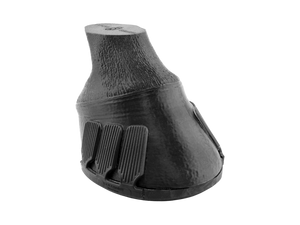
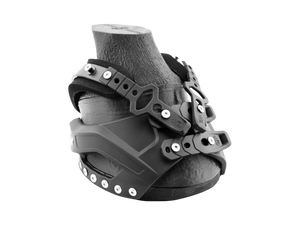
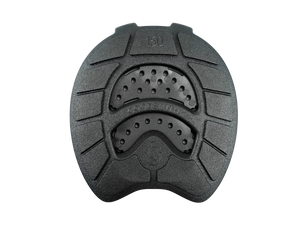
Until then, the hoof needs support so that your horse can walk pain-free. What this support looks like varies greatly from case to case. Was there a rotation or sinking? If so, how severe? How many hooves are affected? How is the horse kept, i.e. what does the footing look like? These and other factors determine how the hooves of your horse can best be supported. In most cases, a cushioning and minimally invasive hoof protection is appropriate, i.e. a hoof boot with pads (which requires good management) or a glue-on shoe with hoof cushion. The advantage of a glue-on shoe over a hoof boot is that the breakover point can be optimised, which is especially essential in cases of rotation. With the Goodsmith, even special constructions (such as fabricating a Steward Clog) are possible to enable the horse to break over pain-free. Your hoof care specialist will decide, in consultation with the vet on site, which type of hoof protection is optimal for your laminitic horse.
If the cause of the laminitis has been eliminated and the hoof is supported during recovery through appropriate trimming or hoof protection, your horse can fully recover from such a laminitis attack and lead a healthy life for the rest of its days.
Author: Nathalie Kurz
Images: Nathalie Kurz
