 Find a hoof expert
 Become a partner



Knowledge about ossification of the lateral cartilages (sidebone)
The horse's hoof looks very rigid from the outside, but it contains several elastic structures inside. These include the collateral cartilages, which sit on the inner and outer branches of the coffin bone in each hoof (see Anatomy). When these cartilaginous extensions ossify, this is referred to as ossification of the collateral cartilages (sidebone). This can affect either one or both collateral cartilages in a single hoof and can occur in either one or several hooves. The front hooves are more frequently affected than the hind hooves.
How does ossification of the collateral cartilages develop?
Ossification of the collateral cartilages develops due to frequent or persistent overloading of the hoof, in particular through concussion (e.g. very hard ground, often in combination with metal shoeing) or incorrect loading due to conformational faults. Toe-wide or toe-narrow stances especially favour ossification of the collateral cartilages, since in these cases the inner or outer side of the hoof is permanently subjected to excessive strain. However, overly high heels or contracted heels can also lead to ossification of the collateral cartilages. In rare cases, a single traumatic event can also lead to ossification of a collateral cartilage.
In addition, heavy breeds or horses with a low height at the withers relative to body mass (i.e. with proportionally short legs) are more frequently affected by ossification.
The hoof essentially tries to counteract the overload by slowly converting the flexible cartilage into stable bone substance. In English, this is therefore also called "sidebone".
The nutritional factor must also be considered: cartilage is not supplied via blood vessels, but must be actively "flooded" with nutrient-rich fluid. However, this only happens during loading and unloading, that is, during movement. It is therefore not only important that the horse is provided with a balanced mineral supply, but also that it is in constant motion so that the cartilage tissue is well supplied and remains healthy. Undersupplied cartilage is more susceptible to ossification.
Prevention, detection and treatment of collateral cartilage ossification
The best prevention against ossification of the collateral cartilages is to avoid the overloads mentioned above, as well as species-appropriate keeping and feeding of your horse.
Nonetheless, collateral cartilage ossification is very widespread – in the early stages, however, horses often show no lameness at all, which is why ossification is frequently only detected at an advanced stage or as an incidental finding. In severe cases, the ossifications can even be palpated at the coronary band or recognised with the naked eye as a kind of "bump". Otherwise, an X-ray provides clarity: the collateral cartilage ossification is visible there as a cloud-like formation in the rear part of the hoof.
Many horses live completely pain-free with collateral cartilage ossification. Depending on the severity, however, the mobility of the hoof can be restricted, which can cause changes in the gait pattern (e.g. stumbling). Due to the reduced elasticity in the hoof, blood circulation in the hoof may also be reduced, which in turn can result in poorer horn growth.
In some horses, collateral cartilage ossification leads to problems because the newly formed bony structures can press on sensitive tissue (e.g. ligaments), which is why horses sometimes show diffuse lameness. This typically appears on hard ground or on tight turns.
In rare cases, the ossified collateral cartilages can also fracture – like any other bone – and therefore lead to marked lameness.
Collateral cartilage ossification cannot be cured, as the ossification process is irreversible. However, with good management, its progression can be halted or at least slowed. To this end, it is necessary to eliminate the causes as far as possible, e.g. correcting conformational faults, reducing excess weight, adapted training, avoiding hard ground, etc.
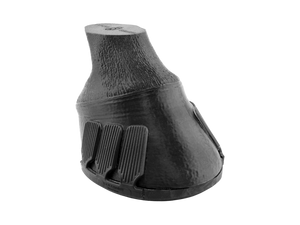
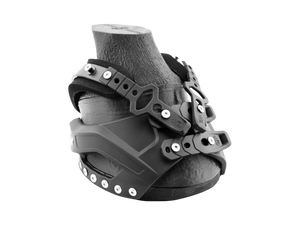
Apart from that, lameness can be reduced by providing the horse with relief through glue-on shoes. Such a plastic glue-on shoe offers good shock absorption and can thus provide a certain amount of compensation for the ossified collateral cartilage.
>> Sources
https://veteriankey.com/ossification-of-the-cartilages-of-the-foot-sidebone/https://www.brookvets.co.uk/sidebone/https://www.dhgev.de/praeparierwerkstatt/erkrankungen/hufknorpelverknoecherunghttps://flexikon.doccheck.com/de/Hufknorpelverkn%C3%B6cherung_(Pferd)http://www.hufrollensyndrom.de/html/krankheitsprozess.html
