 Find a hoof expert
 Become a partner


Nathalie Kurz – hoof care specialist and horse trainer


-
About our Goodsmith partner
Today's hoof care specialist and horse trainer started vaulting and classical riding as a child. Her first own horse was not long in coming…
Years later, through her husband, two more horses joined: a Noriker and an Icelandic horse. Together they moved to a small farm and lived next door to the herd.
With now three horses, she observed alongside how differently the same husbandry, feeding etc. affected the respective hoof situation of the three horses of different breeds.
At first, the young woman focused on training her three charges and wanted to work professionally in this field herself. She chose the equine health trainer course combined with a three-year trainer education in Classical Dressage at the Zentaurus Academy. Later she added a hoof studies course at the ÖGH.
-
The path to the glue-on horseshoe and to Goodsmith
The decisive factor (as is often the case) was her Noriker, who suffered from arthrosis and ossification of the hoof cartilages, and for whom no real help could be found. After a longer phase with iron shoes, barefoot, Duplos and several gluing experiments, Nathalie came across Goodsmith with Ursula Sündermann. "We were truly enthusiastic, because with (comparatively) easy handling we were able to achieve very good shock absorption with astonishing durability on an 850 kg horse."
She decided to do a hoof care training to be able to help her own horse. More and more enquiries came from her environment, which is why Nathalie gave up her main job at a software development company and devoted herself entirely to horses.

-
Goodsmith in Nathalie's work
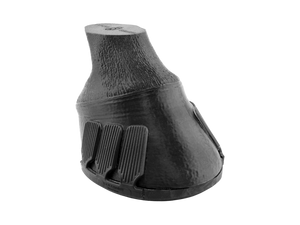
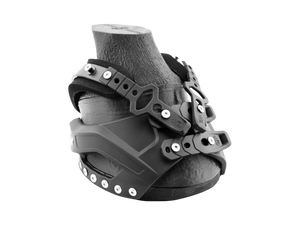
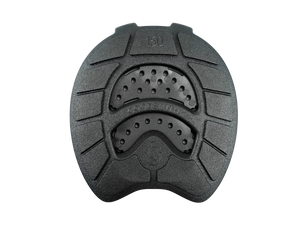
"Goodsmith is my preferred option. Of course, barefoot is always my first choice, as it is the most natural option for the horse and the most uncomplicated for the owner. But barefoot simply does not work for every horse. Then I tend more towards the glue-on glue-on horseshoe than the hoof boot (although this may change thanks to Goodsmith's new 100% customisable hoof boot…). Only in special cases do I not use Goodsmith plates. I greatly appreciate that I can do everything with Goodsmith. It offers a lot of room and I can therefore tailor it individually. However, this is sometimes also a question of time and cost, which is why in rare cases I reach for a somewhat more `pre-fabricated' base plate."
For her laminitis patients the hoof care specialist also reaches for Goodsmith and combines it with the necessary add-ons for the treatment. "I can adapt the glue-on horseshoe very individually during appointments without having to redo everything every time."
-
Experience with the quality of the glue-on horseshoe
The adhesive has never had a negative effect on Nathalie's client horses and even on hooves affected by fungus the Austrian prefers the superglue over the 2-component adhesive. Solubility is good, only minimal amounts are required, and she herself has come into contact with the adhesive several times.
"For the most part, the glue-on horseshoes hold rock-solid; sometimes there can be adhesion problems with horses I do not yet know precisely. Tricky factors can be e.g. the living environment (extreme sloped paddocks), but also other factors… With this information I can take it into account during application and, for example, add side caps."

There are also cases where the hoof expert does not first reach for the glue-on horseshoe. For example, with a necessary daily hoof care for canker or with very deteriorated hoof walls with little available gluing surface. With a current client horse with a nail penetration, Nathalie chose a hoof bandage and a subsequent treatment method with a glue-on horseshoe using a Goodsmith carrier plate solution. It is a kind of cap shoe.
In principle, in her opinion, Goodsmith is easy to process. Mainly due to the consistent materials coming from the same manufacturer, which makes the individual products very compatible. The rest is essentially a matter of practice. "At the beginning I made the mistake of not knowing how much fit tolerance the plate allows and only found out through experimentation that it should sit rather snugly, since the materials provide flexibility and the tabs are stretchable. With too much room, the hoof slides too much or the glue-on horseshoe can come loose."
This experience needs to be built up.
-
Application duration, price and durability of a glue-on horseshoe
On average, special cases excluded, the young hoof care specialist leaves the glue-on horseshoes on the hoof for 6 weeks, because "most of my trimming intervals fall in exactly this range". Of course, there are also cases in which the intervals are shortened. "Often I can reuse the glue-on horseshoe one-to-one. Even with stance corrections or laminitis horses, where I redo the glue-on horseshoes every two weeks, I can often reuse the base plate and tabs again."
It is particularly important to the hoof expert and horse trainer to take time for the horses and their hoof care. "In my dealings with the four-legged friends entrusted to me, I work almost exclusively with positive reinforcement. I meet the animal with patience when it does not understand me or simply does not feel like it. My goal is to motivate the horse to voluntary cooperation. For this I have a small toolset – from treats to strengthen their attention and concentration, to a special mat that, for example, makes standing easier for them when their legs are sore. Especially the young and old client horses are grateful when I approach them with plenty of time and one or another trick, as they cannot hold up their hooves for as long."
A first glue-on horseshoe application for two hooves including trimming of all hooves takes an average of 1½ hours. Prices for her services can be viewed on her website.
She often works in a team, because several tasks can be done in parallel and exchanges can take place – especially in difficult cases.
-
Excursus: applied training with positive reinforcement as a support for hoof care (for tricky horses)
Nathalie's heart project, what she is, unites and lives, is PferdeSinn. An approach to horses based on positive reinforcement.
"The horse world is still stuck in the last century when it comes to training. In other areas, training via positive reinforcement has already become more established, for example in zoos where work is done with dangerous animals and particular caution is required during treatments or hoof care.
It has been found that the animals not only have more fun, but in the long term better executed results can be achieved with less effort required when the animals are motivated (positively convinced)."
Training with positive reinforcement means that "wrong" (by me as a human not desired in the horse) behaviour is not punished or no negative consequences occur, but "right" (by me as a human desired in the horse) behaviour is rewarded.
"This can be done with food training", as Nathalie explains. A treat follows as positive reinforcement. It is important that the horse cooperates voluntarily and does not just execute commands because it would do anything for the treat. Therefore hay cobs are particularly suitable here – they taste good but do not generate an `addiction factor'.

"With hoof care in training, it works simply. As long as the horse gives and holds its hooves, it is positively reinforced. It is important to ensure that the horse actively cooperates and does not endure the hoof care as a passive procedure. The more relaxed the horse, the more relaxed the work is for me as a hoof care specialist."
Nathalie roughly distinguishes three categories of horses that do not stand still during hoof care:
1. Horses that have difficulty cooperating during hoof care due to physical problems or pain.
2. Horses that refuse cooperation due to insecurity or fear.
3. Horses that get bored quickly or simply "don't feel like it".
For all horses Nathalie tries to find the cause and address it instead of simply suppressing the symptoms (the fidgeting). "Either fear has to be taken away by showing the horse with the help of positive reinforcement that it does not have to fear anything painful or unpleasant in what I intend to do with it; or reluctance has to be taken away by giving the horse a reason to want to cooperate with the help of positive reinforcement."

One of her current client horses came out of the stable extremely nervous at the first appointment. Several hoof care professionals had already given up on him. Nathalie could not even touch him. At the first appointment, she could not carry out any trimming but first had to prove to the horse that he would not be surprised and would be informed about every step that was happening. "In the beginning it was important that, when he gave me his hoof, he could also get it back as soon as he asked for it. I did not require him to hold out any longer, because I first had to give him the certainty that nothing bad or against his interest was happening here. As soon as he had understood that, I could encourage him to hold the hoof up for me longer so that I could do my work without complications at later appointments." By now, hoof care runs without problems.
The young horsewoman tries to structure the training so that the horse has no real opportunity to even make a mistake in the first place. "In structuring the training I take care to design it in a way that suits the horse and works for it. If, for example, a horse snaps at me, the problem already lay with me beforehand, because snapping is a very loud and clear expression by the horse, meaning I had overlooked the first signs. If a horse has a balance problem, this should of course be worked on in everyday life. As a hoof care specialist, I do not have the time to take this on myself, but here too I can meet the horse halfway. Instead of forcing the horse to stand still and straight, I look for a wall that the horse can lean against, making it easier for it to give me its hoof and patiently stand on three legs. Horses that still have to learn hoof care or that have had bad experiences with it before, I like to let stand "more freely", because when tied up they feel cornered more quickly, since they do not have the possibility to express themselves physically. They are more restricted in being able to `defend themselves', which can lead to an increase in fear and aggressiveness – counterproductive to my work. Standing freely they feel safer. Of course, this means that my horse may also take three steps away, but it lets me back in faster and more easily, since it notices that we are working together and respecting its needs. This is a very suitable training method when the horse first has to learn to stand tied up or to regain trust."

With a young Arabian, cooperation during hoof care was lacking. He fidgeted and quickly became impatient. Nathalie therefore tried to shorten the intervals so that the hoof care sessions themselves did not take too long. In addition, she had the owner do mental work with the animal during this time so that his impatience was kept occupied. "I noticed that he wanted to be kept busy. I therefore decided not to acclimate him to the situation with treats, but rather to address his urge to play. In his case this was easily possible, because he already had an excellently developed sense of balance and did not have to concentrate on it for the hoof care in order not to stand wobbly."

