 Find a hoof expert
 Become a partner


Navicular syndrome: everything you should know
Navicular inflammation, podotrochlosis, palmar foot pain, navicular bone disease: many names for a broad clinical picture
Navicular syndrome is a common lameness diagnosis in riding horses and often strikes fear into horse owners, as it is still considered incurable in many places. The good news is: this is not always the case. Over time, diagnostic tools have improved significantly and more has been learned about the disease and, above all, its causes, which is why today not all patients with navicular disease are automatically "hopeless cases".
Help, my horse has navicular disease!
To understand why navicular disease is so varied in its prognosis and treatment, we need to take a closer look at the anatomy. Because: every horse has a navicular apparatus! To be precise, every hoof contains what is called a navicular complex. This consists of:
- Navicular bone (a small elongated bone in the hoof that acts as a "pulley" for the deep digital flexor tendon)
- Connecting ligaments of the navicular bone to the coffin bone and short pastern bone (= upper and lower navicular ligaments)
- Insertion of the deep digital flexor tendon, which passes over the navicular bone
- Navicular bursa, which ensures the smooth "rolling" of the tendon over the bone
- Portion of the coffin joint
All of these components of the navicular complex can become diseased and cause the same symptoms. The symptoms are often diffuse and not constant: frequent stumbling, stiff gait, lameness especially on tight turns and hard ground, avoidance of loading the rear part of the hoof (toe-first landing), often both front hooves affected. However, the same symptoms can also occur when other structures in the rear area of the hoof are painful. That is why in the English-speaking world people often no longer speak of "navicular syndrome" (= the correct translation for "Hufrollensyndrom"), but instead of "palmar foot pain" or "caudal heel syndrome".
Diagnosis
But how do you know exactly whether the navicular complex is actually diseased or another structure? And if it is the navicular complex: which of its components?
The answer is often difficult in practice. Using regional nerve blocks, it can only be determined whether the rear hoof area is actually causing the pain, but not exactly which part inside the hoof. X-rays, in turn, can only visualize bone, i.e. they can only determine whether the navicular bone is healthy. In the past, the diagnosis of "navicular disease" was made as soon as enlarged vascular channels became visible in the navicular bone. However, these can also arise from other problems (e.g. a previous and already healed coffin joint inflammation) and say nothing about the acute condition. In addition, these navicular bone channels only develop over time and are therefore not yet visible on X-rays at the beginning of the disease.
Fortunately, another imaging technique has become widespread in the veterinary field in recent years, which can also be used to examine soft tissues: magnetic resonance imaging (MRI). This makes it possible to visualize tendons and ligaments as well. A reliable diagnosis of navicular disease can therefore only be made by MRI. In all other cases, it cannot be ruled out that a completely different part in the hoof is actually causing the pain.
Causes of navicular disease
Since the navicular complex consists of so many different structures, there are also a wide range of causes that can irritate or damage each of these structures. In rare cases, trauma can also lead to the disease; however, in the vast majority of cases it is overuse of the deep digital flexor tendon, too much pressure on the navicular complex, or reduced blood circulation that leads to navicular syndrome. Specific causes of these problems can be:
- Hoof conformation:
- flat (negative) coffin bone angle: each 1 degree of angle reduction means 4% more strain on the deep digital flexor tendon
- very upright hoof (reduced hoof mechanism)
- toe too long (additional strain on the deep digital flexor tendon during breakover)
- too little "shock absorption" (lack of soft tissue), e.g. due to contracted hooves or ossification of the collateral cartilages
- too much weight for the hoof size (hooves too small or overweight)
- lack of movement
- unnatural movements (especially high speed on circles, jumping, general overloading of the forehand)
Is navicular syndrome treatable?
As mentioned at the beginning, navicular disease was long considered incurable because it was assumed to be a degenerative disease of the navicular bone. In today's practice, however, it is much more a question of which part of the navicular complex is actually diseased (soft tissue or bone) and why (clarifying the causes) or what stage the horse is in. Bony changes are irreversible, but can often still be managed well. Problems with the affected tendons, bursa or ligaments are often protracted, but depending on the cause, they can frequently subside completely.
Treatment must therefore be individually tailored depending on the cause. It is important to thoroughly investigate the cause so that it can be eliminated, e.g. through an optimized exercise regimen or changed housing conditions.
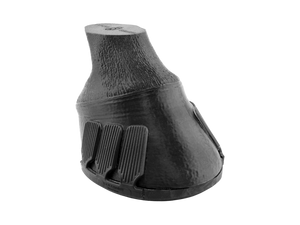
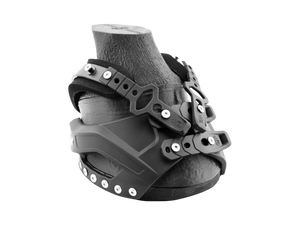
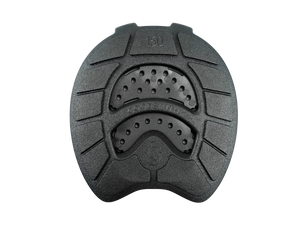
However, since "true" navicular disease often cannot be differentiated from other pathological conditions in the rear hoof area, the first measure should always also be to optimize hoof health. In some cases, simply correctly shortening the toe or eliminating a contracted heel or negative coffin bone angle is enough to achieve improvement. If necessary, it may make sense to additionally apply orthopedic hoof protection (e.g. to raise the heels, relieve the deep digital flexor tendon, or for additional cushioning).
Apart from that, painkillers, circulation-promoting medications or injections (into the joint or bursa) may be indicated, depending on which structure is affected.
Sometimes you also hear that a nerve resection ("neurectomy") is recommended or performed on a "navicular horse". This involves cutting the nerve that is responsible for transmitting sensation in the rear hoof area. As a result, the horse no longer feels this area and is therefore free of lameness. However, it must not be forgotten that the actual cause continues to exist and, in most cases, progresses unnoticed – the horse simply can no longer feel the deterioration. Since the severed nerve is responsible for the entire rear hoof area, the horse also no longer has any other sensations in this area, e.g. regarding the ground surface. The horse is quite simply numb in the rear part of the hoof, which sometimes causes other problems (e.g. abscesses or injuries) to be overlooked.
In addition, it is not uncommon for the nerve endings to grow back together after a few years, so that the horse regains its sensation and the lameness then often reappears much more severely (because the actual disease has progressed in the meantime).
A neurectomy must therefore be carefully considered and is not a simple solution, but rather a way of masking the problem if a pain-free life would otherwise no longer be possible for the horse.
Author: Nathalie Kurz
>> Sources
https://vetmed.illinois.edu/2020/09/11/navicular-syndrome/ https://extension.usu.edu/equine/research/equine-navicular-syndrome http://www.hufrollensyndrom.de/index.html https://www.pferdeklinik-aschheim.de/hufrollensyndrom-beim-pferd/ https://kernkompetenz-pferd.de/episode-23-hufrollen-erkrankung/ https://www.tierspital.uzh.ch/pferdekliniken/nervenschnitt/ https://www.usef.org/media/equestrian-weekly/is-it-navicular-syndrome-things-you-should-know
